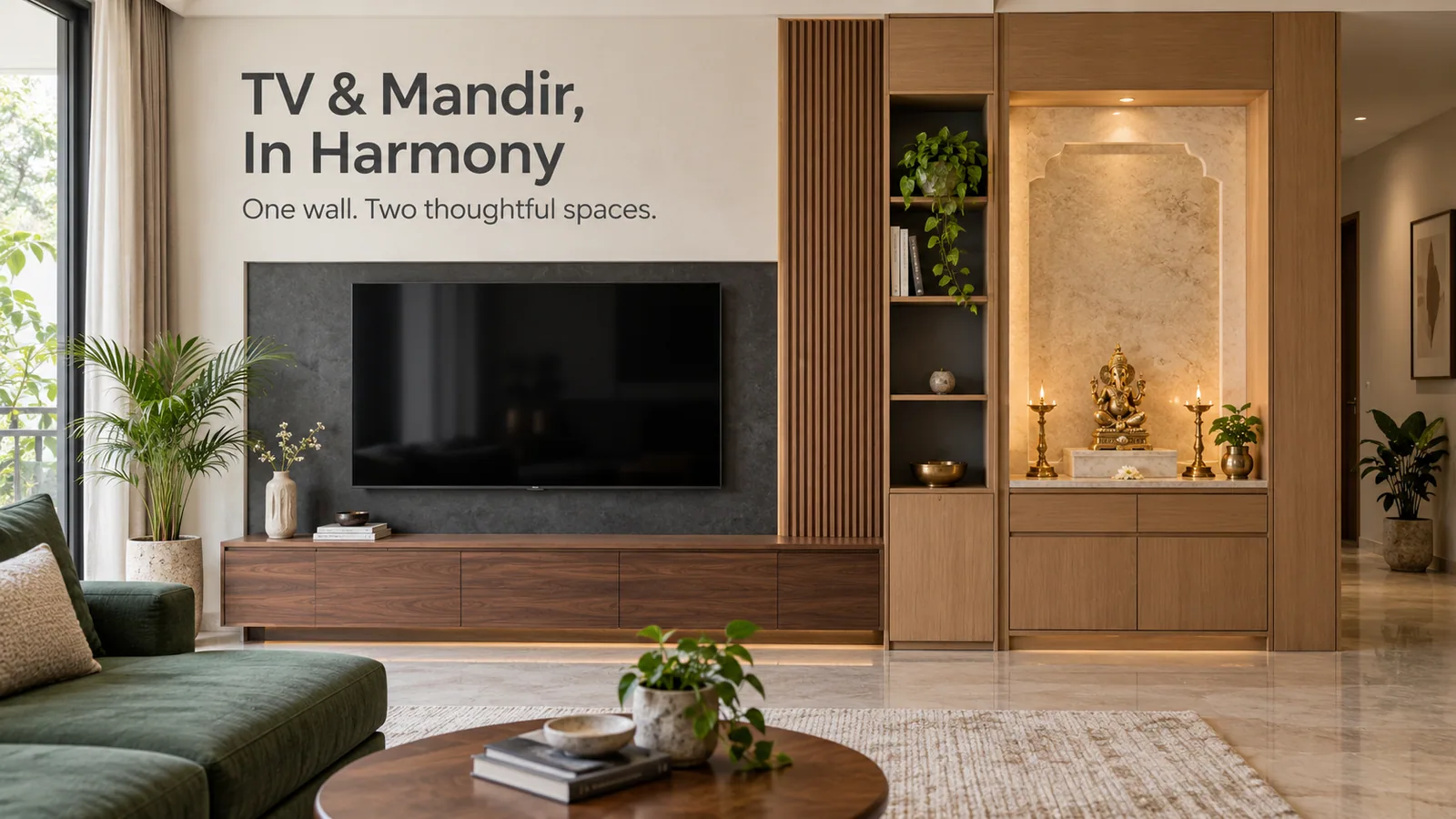
A TV unit with mandir works well when the mandir is clearly separate from the screen: in its own niche or cabinet beside the TV, with its own lighting and ideally a shutter. Keep at least 1 to 1.5 ft of panel or a partition between the edge of the TV and the mandir, place the deity at a comfortable height for how your family prays, and plan for diya heat and smoke from the start.
In many Indian flats there is no room for a separate pooja room, so the living-room wall has to hold both. Done carelessly, the mandir looks like a shelf next to the TV. Planned well, the two share one design and still feel separate. Here is how to plan the layout, sizes, safety, storage and finish.
Six TV unit with mandir layouts
Layout | How it works | Best for |
|---|---|---|
Side-by-side | TV panel on one side, mandir niche on the other | Most living rooms with a 9 ft or wider wall |
Mandir in a tall cabinet | Mandir inside a tall unit with shutters next to the TV | Families who want it closed when not in use |
Floating mandir | Wall-mounted mandir on the same panel, beside a floating console | Small halls; keeps the floor clear |
Corner mandir | Mandir in the corner next to the TV wall, matched in finish | Narrow TV walls |
Mandir with jali or glass shutters | Screened shutters that show the deity but separate the space | Homes that want privacy and visibility |
Full-wall unit | TV in the centre, mandir in one tower, storage in the other | Large halls and families who need storage |
Avoid putting the mandir directly above or below the TV. It is hard to separate visually, the deity ends up at an awkward height, and the TV's heat and wiring sit close to the diya.
How much space to keep between the TV and the mandir
Plan the wall in three parts: the TV zone, a separating zone and the mandir zone.
Separation: at least 1 to 1.5 ft of plain panel, a vertical fin or a change of finish between the TV edge and the mandir
Mandir width: about 1.5 to 3 ft, depending on the number of idols and frames
Mandir depth: about 12 to 15 inches, enough for idols, a diya and a small thali
Wall width needed: a 55-inch TV with a balanced panel and a 2 ft mandir needs roughly 9 to 10 ft of wall
For layouts that suit different hall sizes, see the living room TV unit guide.
Heights for the mandir and the TV
The TV and the mandir follow different rules, which is another reason to keep them side by side rather than stacked.
Element | Planning height from the floor |
|---|---|
Centre of the TV screen (seated viewing) | About 40 to 45 inches |
Deity platform for standing prayer | About 3 to 3.5 ft |
Deity platform for prayer seated on the floor | About 1 to 1.5 ft |
Top of the mandir niche | At least 1.5 to 2 ft above the diya |
Decide whether your family prays standing or seated before the design is drawn. It changes the height of the mandir and whether you need a drawer for a floor mat.
Diya, agarbatti and safety
This is the part most TV-wall designs forget.
Heat: keep a clear height of at least 1.5 to 2 ft above the diya. Use a metal or glass plate under the diya so the flame never sits on the shelf.
Smoke and soot: agarbatti and diya smoke darken the inside of a closed niche. Jali or perforated panels, or a gap at the top, let it escape.
Finish near the flame: avoid gloss acrylic directly above the diya. A matte laminate or painted finish is easier to clean and handles warmth better.
Cables: run TV and power cables away from the mandir side of the panel.
LED diyas: families who light a diya only on special days often use an LED diya for daily prayer.
Storage and lighting for the mandir
Storage
A drawer below the mandir keeps agarbatti, matchbox, diya oil, the thali and bells in one place. A small shutter cabinet below can hold prayer books and seasonal items. Keep this storage separate from the TV console, so remotes and set-top boxes don't mix with pooja items. If the mandir sits in a tall cabinet, a pull-out shelf at platform height gives room to place the thali during aarti and slides back in afterwards.
Lighting
Warm LED strip lights inside the mandir niche, on a separate switch from the TV panel lights, make the mandir the focus in the evening. A backlit jali panel behind the deity is a popular detail. Keep the lights warm white; cool white looks harsh on brass and marble idols.
Finishes for a TV unit with mandir
Use one finish family across the wall so the TV and mandir look designed together, then mark the mandir with a change in texture or colour.
Finish | Works well for |
|---|---|
Wood-grain laminate | Warm, traditional look across the wall |
White or ivory PU paint | Calm mandir niche with a premium finish |
Fluted panel | Separating fin between the TV and mandir |
Glass shutters | Screened mandir that keeps dust out |
Jali panels | Mandir back panel or shutters, with backlighting |
Reedify makes TV units and pooja units in laminate, acrylic, PU paint, painted gloss and glass on plywood or HDHMR, with fluted and backlit panels. Reedify does not offer veneer. See more on the pooja unit page and in the pooja unit design guide.
Placement and vastu
Many families follow vastu for the mandir, which usually means a north-east location with the deity facing east or west. If this matters to you, decide the mandir wall first and plan the TV around it, not the other way round. Tell the designer at measurement so the 3D layout reflects it.
Common mistakes with a TV unit and mandir
No separation: the mandir looks like a decor shelf next to the screen.
Mandir above the TV: too high for prayer and too close to the TV's heat and cables.
No space for the diya: a shallow niche with a low top that blackens within months.
Shared drawers: remotes, chargers and pooja items mixed together.
Gloss everywhere: reflections on the screen and soot marks on shiny shutters.
What a TV unit with mandir costs
The TV console part of a Reedify TV unit starts at around ₹1,000 per sq ft of front area, plus GST. The panel, the mandir niche, jali work, glass shutters and lighting are quoted on the final design, because they vary so much between homes. You get a fixed, itemised quote after the free site measurement and 3D design.
Get your TV unit with mandir designed in 3D
Send these to Reedify on a call or WhatsApp at +91 98120 53001:
A photo of the TV wall and its width and ceiling height
Your TV size and where the sockets are
Whether your family prays standing or seated, and any vastu preference
The number and size of idols and frames for the mandir
Two or three reference photos you like
Reedify measures the wall for free, prepares a 3D design showing the TV, mandir, storage and lighting together, and gives a fixed quote. Nothing is cut until you approve the design. Start on the TV unit page.