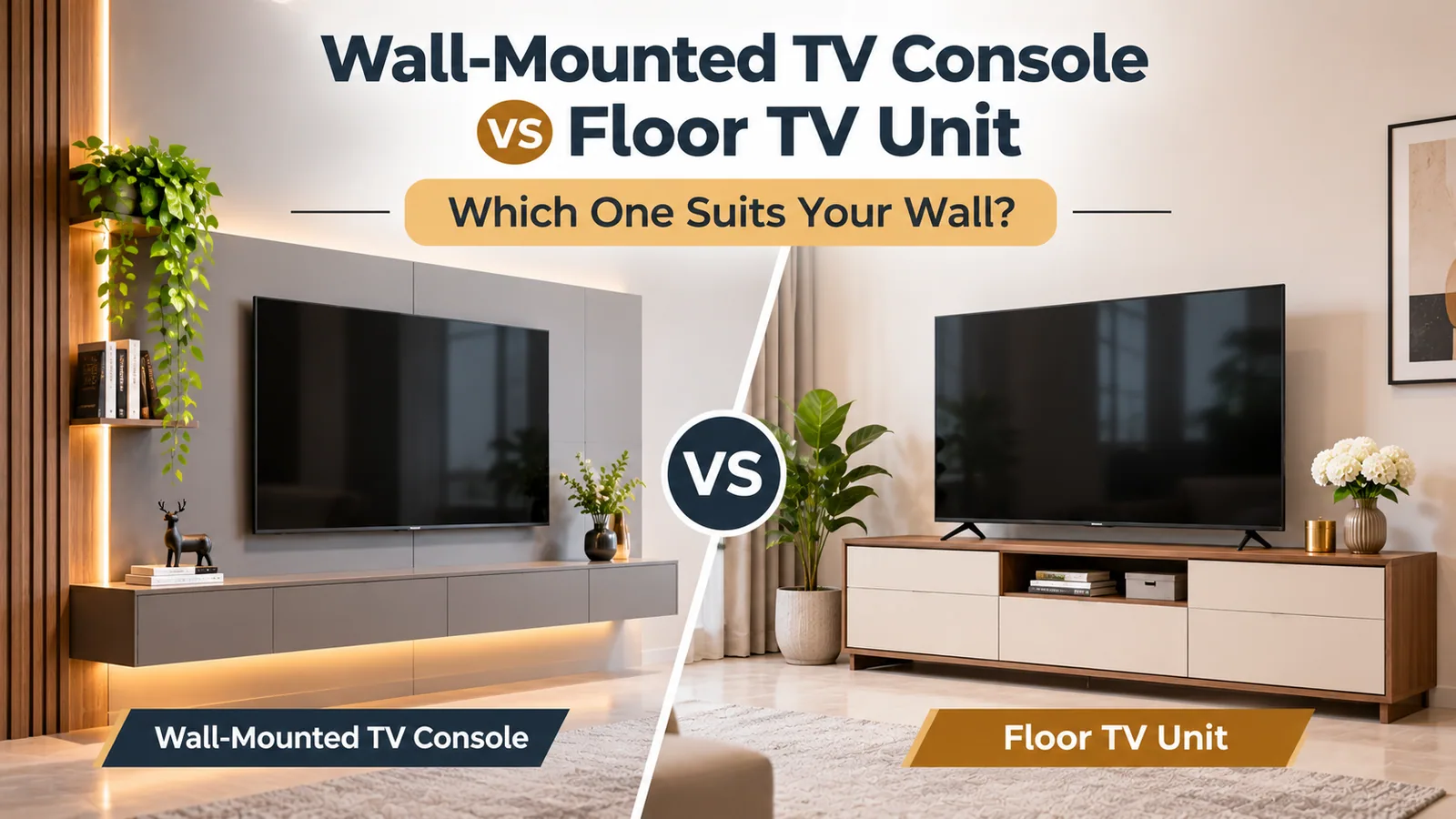
Choose a wall-mounted TV console if you want a clear floor, a lighter look and easy cleaning, and your wall is solid brick or concrete. Choose a floor-standing TV unit if you need deep storage for many devices, your wall is a gypsum or drywall partition, or you are in a rented home where heavy wall fixing is a problem.
Both can look built-in when they are made to measure. The decision comes down to the wall you have, what you need to store, and how you want the room to feel.
Quick comparison
Factor | Wall-mounted (floating) console | Floor TV unit |
|---|---|---|
Look | Light, modern, floor stays visible | Grounded, more furniture-like |
Floor cleaning | Easy; mop or robot vacuum goes under | Dust collects around the base |
Storage | Moderate; usually 12–14 in deep | More; usually 16–18 in deep with closed cabinets |
Wall needed | Solid brick or concrete, or a reinforced partition | Any wall |
Wiring | Must be planned before fixing; best concealed in the wall | Easier to route behind the unit |
Rented homes | Needs landlord approval for wall fixing | Can move with you |
Best rooms | Living rooms, bedrooms, small flats | Large halls, homes with many devices |
When a wall-mounted TV console is the better choice
Small living rooms and bedrooms. Seeing the floor run under the unit makes the room feel larger.
Homes with robot vacuums or daily mopping. No base means no dust line.
Minimal or handleless designs. A floating console with push-to-open shutters gives the cleanest TV wall.
TV mounted on the wall anyway. If the screen is on a bracket, a floating console underneath keeps the whole wall consistent.
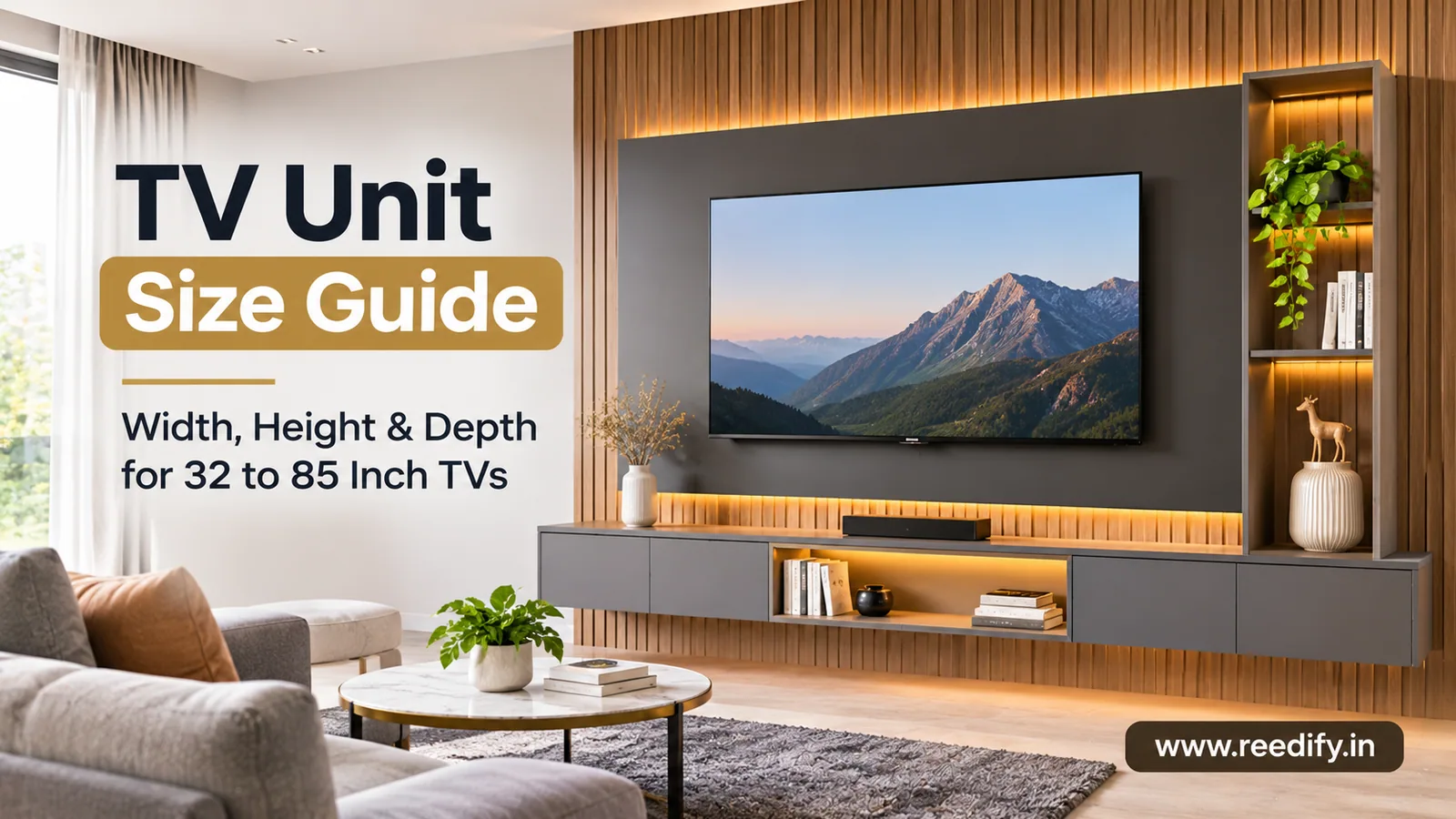
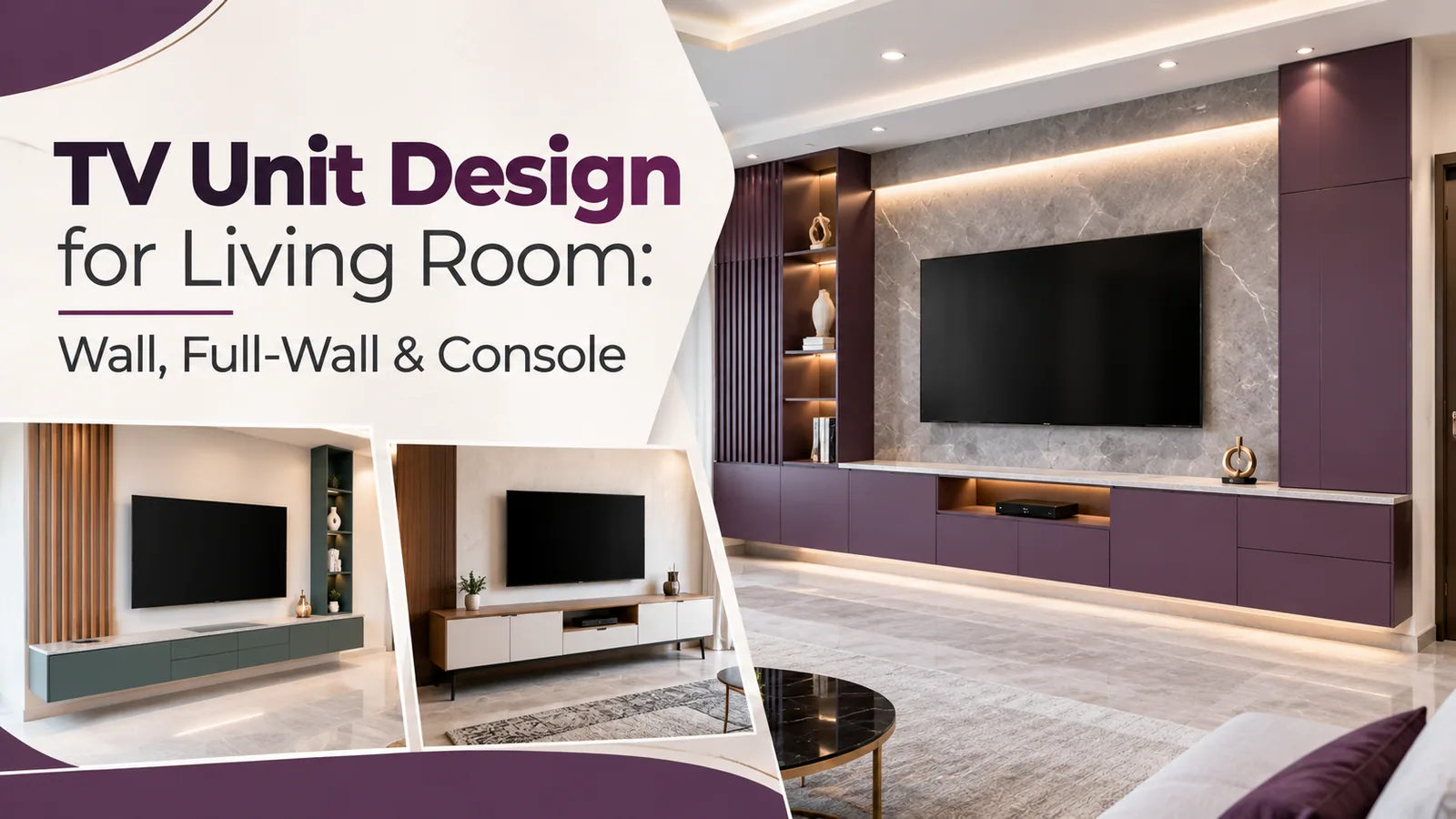
A common height for the bottom of a floating console is about 6 to 12 inches above the floor, high enough to clean under, low enough to keep the TV at a comfortable height above it. For looks that combine a floating console with a back panel or display niches, the living room TV unit guide compares the main styles.
When a floor TV unit is the better choice
Lots of devices. A gaming console, set-top box, router, soundbar subwoofer and speakers need depth and ventilation that a slim floating unit can't always give.
Heavy storage. Books, photo albums and crockery in a closed lower cabinet are better on the floor.
Partition walls. If the TV wall is a gypsum or board partition, a floor unit avoids loading it.
Rented homes. A floor unit can be moved to your next home with little change.
Check your wall before you decide
The wall decides what you can safely hang. During the site measurement, Reedify's team checks the wall, height and depth, and where the plumbing and electrical points are.
Wall type | Common in | What it means for a floating console |
|---|---|---|
Brick or RCC (concrete) | Independent houses, older flats, builder floors | Best for wall-mounting; standard fixings hold well |
AAC block | Many newer NCR high-rise flats | Can be wall-mounted, but needs fixings made for AAC block |
Gypsum or board partition | Office-style flats, some internal walls | Needs a hidden support frame, or choose a floor unit |
If you are not sure what your wall is made of, ask before you finalise the design. A floating console that is fixed with the wrong anchors is the most common reason these units sag.
Plan the wiring before the console is fixed
A floating console looks clean only if no wires show below it. Decide these before the wall is painted and the unit is made:
Power sockets behind the TV and inside or behind the console, so plugs don't sit on top
A concealed conduit from the console up to the TV bracket for HDMI and power cables
A vented section for the set-top box and router, which get warm when closed in
Soundbar position either on top of the console or on its own bracket below the TV
On a Reedify TV unit, routing for power, set-top box, soundbar and gaming consoles is planned in the 3D design before any panel is cut. That is how the finished wall shows no cables.
How a wall-mounted console is installed
On a Reedify job, installation follows the approved 3D design:
Site check. The measurement team records the wall size, wall type, and the position of sockets and switches.
Design and wiring plan. Socket heights, the conduit route and the device shelf are fixed in the 3D before production.
Factory build. The console is cut, edge-banded and drilled in the Rohtak factory, and its shutters are aligned on the bench.
Fixing. The installer marks a level line, fixes the console to the wall with fixings suited to that wall, and checks it for level again under load.
Shutter adjustment and handover. Push-to-open or soft-close shutters are adjusted on site, cables are dressed, and the area is cleaned.
Finishes and details that suit each style
Floating console: laminate in a wood-grain or matte colour, or acrylic for a gloss look; push-to-open shutters; a profile light underneath for a soft glow on the floor
Floor unit: closed lower cabinets with drawers for remotes and games, open niches for décor, and a back panel to tie it to the wall
Reedify's TV units come in laminate, acrylic, PU paint, painted gloss and glass. Reedify does not offer veneer.