
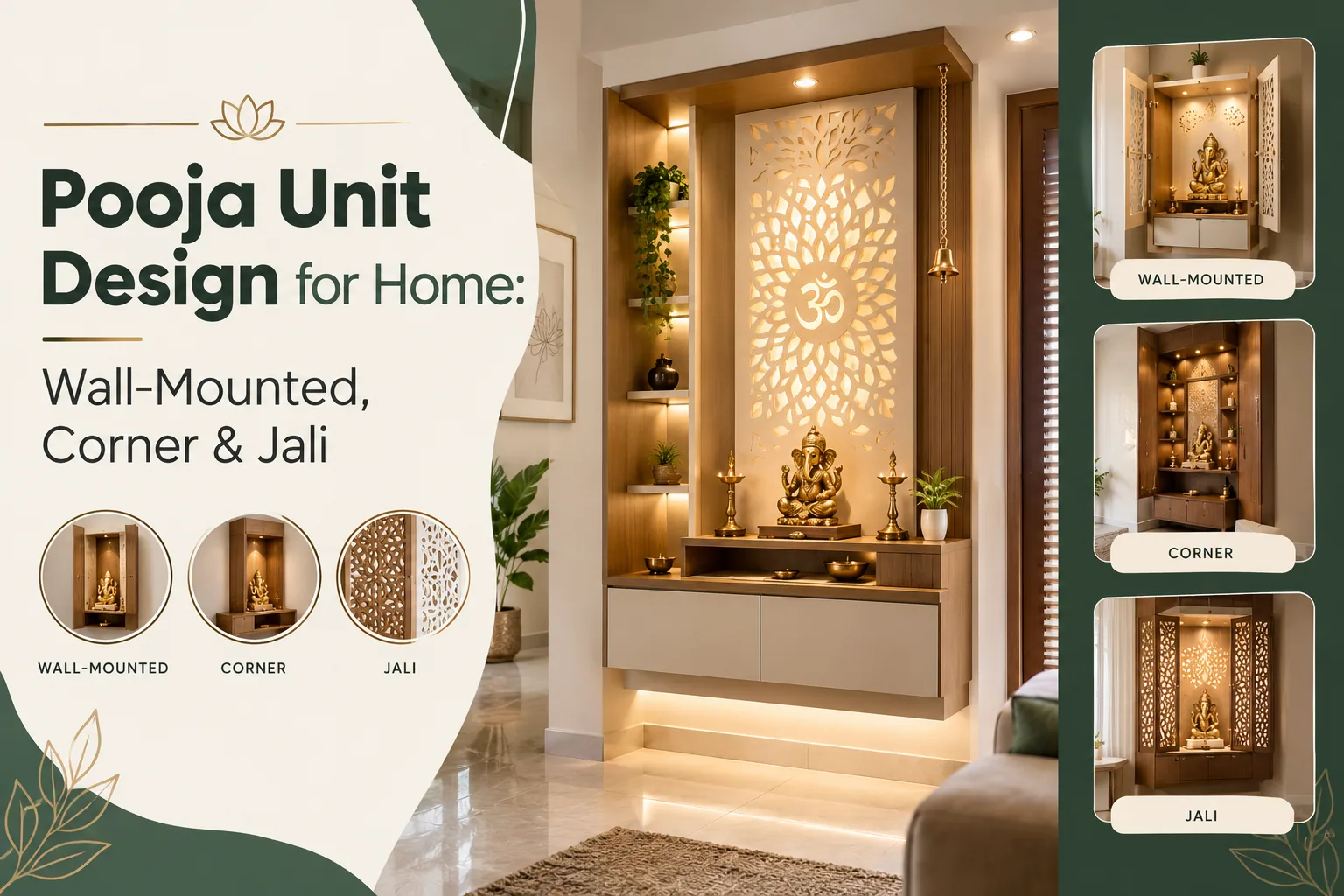
A good pooja unit design starts with how your family prays, not with a picture of a carved mandir. Do you pray standing or seated on the floor? Is a diya lit every day? How many idols and frames need space? Where in the home is there a quiet wall? Answer these first and the format, size, door and lighting choices become straightforward.
This guide covers the main pooja unit formats, placement, height, door designs, materials, lighting and storage, along with the safety details that are easy to miss when a mandir is designed only for looks.
Choose the Right Pooja Unit Format
Format | What it looks like | Best for | Things to check |
Wall-mounted | A mandir fixed to the wall with the floor clear below | Flats and compact homes; families who pray standing | Wall strength; height of the idol shelf |
Full-wall / floor-standing | A larger unit from floor level, often with storage below | Homes with a dedicated corner or room; seated worship | Ventilation for smoke; space in front for sitting |
Corner | A unit shaped to fit an unused corner | Halls with a dead corner; small apartments | Door swing inside a tight corner |
Jali | Front or back panels with cut patterns, often backlit | Homes that want privacy with visibility | Dust in the jali; cleaning access |
With attachment | Mandir combined with another unit such as a TV wall | Compact homes where one wall does two jobs | Separation between the mandir and the other use |
Most apartments end up with a wall-mounted or corner unit simply because floor space is limited. Independent houses and larger flats more often have room for a floor-standing mandir with a seating area in front.
Where to Place the Mandir
Many families follow Vastu for placement. As traditionally followed, the pooja ghar is placed in the north-east corner of the home, with idols facing west so the person praying faces east. Common things to avoid are placing the mandir under a staircase, against a bathroom wall or directly facing the main door.
Practical placement matters as much as direction:
Keep it out of a main walkway, so nobody brushes past a lit diya.
Avoid positions directly under a ceiling fan or in front of an air-conditioner outlet, which push smoke and flicker the flame.
Leave clear space in front for the family to stand or sit together during aarti.
Check that a door or wardrobe shutter nearby does not swing into the mandir area.
Where the ideal corner is not available, families usually choose the closest practical position and follow their own customs. A designer can show two or three options on the floor plan before you decide.
Get the Height and Proportions Right
The idol shelf height depends on how you pray. If the family prays standing, the idols are usually placed around chest height so they can be seen and reached comfortably. If the family sits on the floor for puja, a lower platform keeps the idols close to eye level when seated. Decide this first; it sets the height of everything else in the unit.
Three proportions are worth checking on the drawing:
Depth of the idol shelf: enough for the idols plus a diya and a small plate in front of them, without reaching over the flame.
Clearance above the diya: keep the shelf or ceiling of the unit well above the flame so heat and soot do not mark the panel.
Width for the family: a mandir that is too narrow for the number of idols and frames you own looks crowded within weeks.
Pooja Unit Door Designs
Doors are one of the most searched details in pooja unit design, because they change both the look and the daily routine.
Door type | Advantages | Trade-offs |
Open (no door) | Idols always visible; nothing to open before puja | Dust settles daily; more frequent cleaning |
Clear glass | Keeps dust off while idols stay visible | Shows fingerprints; needs a wipe after use |
Frosted or patterned glass | Adds privacy and softens the view | Idols not clearly visible when closed |
Jali overlay | Traditional look; light passes through backlit patterns | Dust collects in the cut-outs |
Wooden carved | Fully closed and private between prayers | Idols hidden; heavier shutters |
In tight corridors, sliding or bi-fold doors avoid a shutter swinging into the walkway. If bells hang inside the unit, leave enough height so they do not strike the door frame when it closes.
Materials and Finishes
Teak and sheesham are the traditional solid-wood choices for a wooden pooja ghar. For better value and seasonal stability, many units are built in MDF or HDHMR with a teak-look laminate. On its pooja unit page, Reedify Modulars lists both routes, and finishes such as laminate, acrylic and PU paint. Reedify does not offer veneer.
For a mandir where a diya and agarbatti are lit daily, two finish qualities matter: it should wipe clean of oil and soot, and it should not be the surface directly under the flame. Place the diya on a metal plate or tray rather than on the laminate itself. Popular colours include warm wood tones such as honey teak and walnut, soft ivory or off-white, and matt black with gold inlay. The
Lighting the Mandir
Warm LED lighting gives a calm glow and reduces how much the space depends on the diya for light. Two layers usually work well: a soft cove or strip light along the top or back panel, and a small spot light on the idols. Plan the switch outside the unit, at a height that does not need reaching over the diya, and have the wiring concealed inside the panels during manufacturing rather than taped on afterwards.
Keep LED strips and drivers away from the diya position. Heat from an open flame shortens the life of electronics placed directly above it.
Storage for Samagri
A pooja unit without storage turns into a shelf of matchboxes, oil bottles and agarbatti packets within a month. Plan storage around what you use:
A shallow drawer for agarbatti, matchbox, cotton wicks and camphor.
A separate drawer or tray for oil and ghee, kept away from books and cloth.
Space for the aarti thali, bell and small vessels.
A cabinet below for religious books, festival items and, for floor-seated worship, a rolled asan or mat.
Pooja Units in Small Flats
In compact apartments the mandir often shares a wall with something else, most commonly the TV. This works when the two are clearly separated: the mandir sits in its own niche, never directly above, below or in line with the TV, and both are designed together so finishes and lines match. A
Wall-mounted and corner units are the other space-saving options. A wall-mounted mandir keeps the floor clear; a corner unit turns an unused corner of the hall into a dedicated space.
Common Mistakes to Avoid
Designing the carving first and checking idol sizes later.
Placing the diya shelf directly under a laminate or LED panel.
Forgetting storage, so samagri ends up on the idol shelf.
Choosing an open mandir in a dusty location without planning for daily cleaning.
Putting the switch inside the unit, so it has to be reached over the flame.
What Affects Pooja Unit Cost
Price depends on size and format, the material, the level of carving or jali detail, the door type, lighting, hardware and installation complexity. A plain wall-mounted mandir and a full-wall unit with CNC jali and layered lighting sit at very different points. A reliable estimate follows a site visit and a discussion of your wall size, preferred format and finish.
How Reedify Modulars Builds a Pooja Unit
Reedify Modulars designs each
Share your wall size, the number of idols and whether you pray standing or seated when you