Headcount Is Not Occupancy
The question that decides a hybrid floor is simple and rarely asked properly: how many of our people are in the building on the busiest day of a normal week?
Headcount is easy to obtain and wrong for this purpose. Furnishing to headcount in a leased Cyber City floor, where carpet area is fixed and every square foot is committed for the length of the lease, means paying for positions that are empty most of the week. Furnishing to average attendance is the opposite mistake, because the average day is not the day people complain about.
The number you want sits in between: the peak. And the only honest way to get it is to measure rather than estimate.
Build an Attendance Matrix Before Anything Else
Take four normal weeks, exclude holidays and anything unusual, and record how many people from each team were in the office on each day. Access-control or visitor-system data usually gives you this without a survey.
The illustrative matrix below shows what the output looks like for a hypothetical 80-person company. The numbers are an example of the method, not a finding about Gurgaon offices.
Team | Headcount | Mon | Tue | Wed | Thu | Fri |
|---|---|---|---|---|---|---|
Delivery | 40 | 22 | 34 | 36 | 30 | 12 |
Sales | 15 | 6 | 9 | 11 | 9 | 5 |
Finance and HR | 10 | 8 | 9 | 9 | 8 | 6 |
Leadership | 5 | 3 | 4 | 5 | 4 | 2 |
Daily total | 70 | 39 | 56 | 61 | 51 | 25 |
Two things fall out of a matrix like this immediately. The peak is a specific day, not a vague sense that midweek is busy. And the teams behave differently: finance and HR are close to fully present every day, while delivery swings by a factor of three.
That second observation is the one that decides the furniture. A team that is always in should have assigned desks. A team that swings should be the one sharing.
Choosing the Design Number
Once you have the peak, three decisions follow.
Which peak do you furnish for? The highest single day in the sample, or the second highest, depending on how tolerable an occasional shortfall is. Furnishing to the absolute peak of a four-week sample is safe; furnishing to the average guarantees a bad Wednesday.
What allowance do you add? Hiring, visitors from other offices and the days when a policy exception brings everyone in. A modest allowance above the peak is normal. Decide the number deliberately and write down the reasoning, because this is the figure finance will ask about.
Where does the saved area go? If the peak is meaningfully below headcount, the recovered area should not simply disappear. Hybrid floors need more meeting and huddle space than fully assigned floors, because people come in specifically to meet. Converting some of the saved desk area into meeting capacity is usually a better outcome than a sparse floor.
What Changes When Seats Are Shared
Shared seating is not the same furniture with fewer desks. Four things change.
Personal storage moves off the desk. If nobody owns a position, a mobile pedestal under it no longer works. You need lockable personal storage away from the seating, sized to what people actually leave in the office.
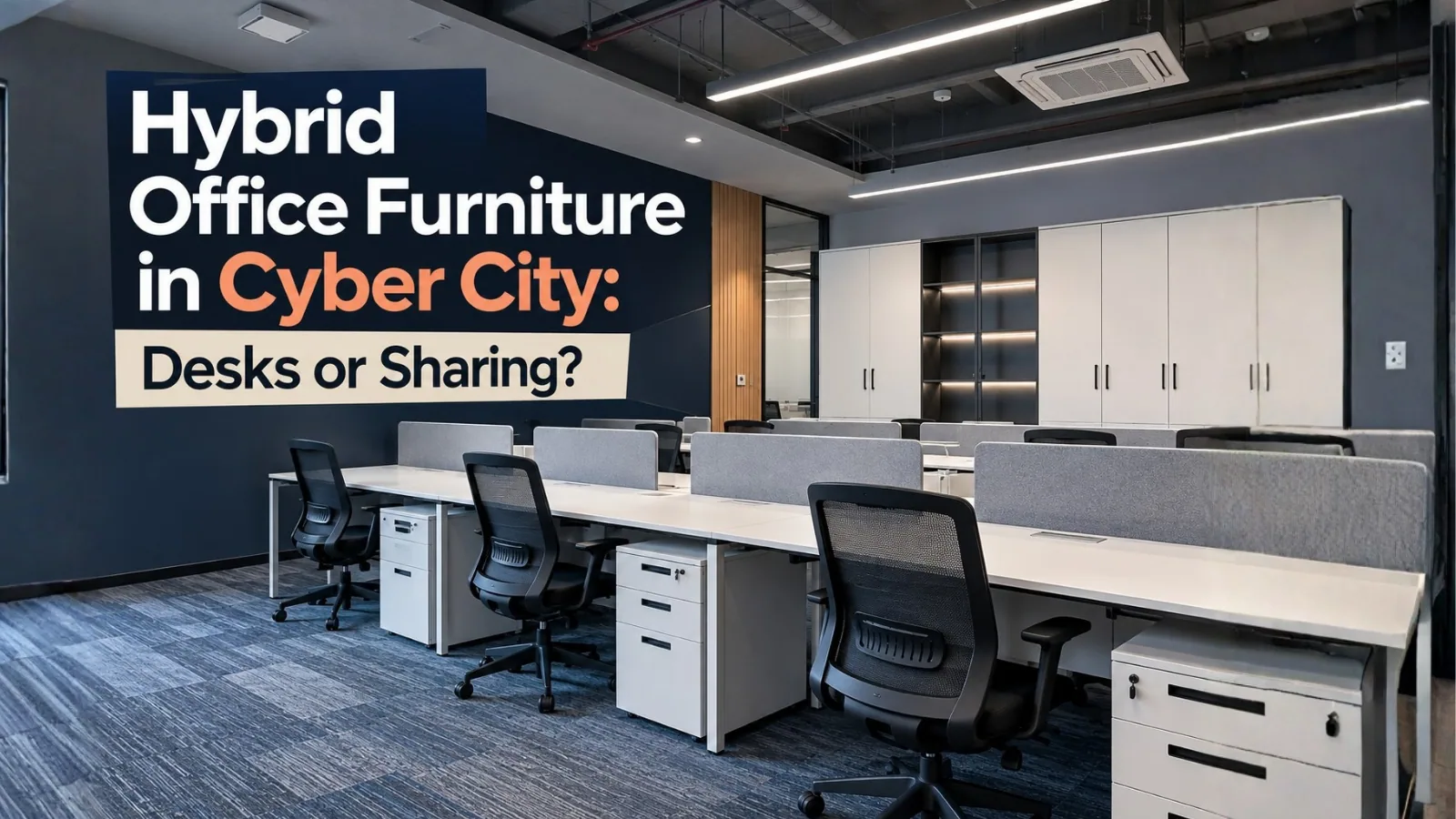
Desks need to be uniform. Shared positions must be interchangeable, which means the same width, depth, monitor arrangement and power provision at every seat. A floor of slightly different desks does not work as a shared floor.
Screen height falls. Shared floors work better with lower screens or bench arrangements, because nobody is personalising a position and visibility helps people find a free seat.
Clear-desk becomes a furniture requirement. Somewhere has to absorb what is on the desk at the end of the day. That is storage capacity, and it has to be planned rather than assumed.
What the Matrix Will Not Tell You
Attendance data is the right starting point and it has three blind spots worth covering before you commit to a number.
It records the pattern under the current policy. If the policy is about to change, or is being enforced loosely and is about to be enforced properly, the historic data describes an office that is about to stop existing. Ask whether anything is changing before you treat four weeks as representative.
It does not capture events. Quarterly reviews, client visits, training weeks and town halls bring people in at levels the routine weeks never show. Those days do not justify furnishing to headcount, but they do justify knowing which space absorbs them.
And it does not tell you why people came in. A team that attends on Wednesdays because that is when it meets needs meeting capacity more than it needs desks. A team that attends because the work requires equipment on site needs the desks. Ten minutes with each team lead separates the two.
Meeting Space Is the Other Half of the Decision
On a hybrid floor, the demand curve for meeting rooms is not flat. If most of the office comes in on the same two days, the meeting rooms are contested on those days and idle on the others, which is why hybrid offices frequently report a room shortage while the average utilisation figure looks comfortable.
Plan meeting capacity against the peak day for the same reason you plan desks against it. And weight it towards smaller settings rather than one large room: a pair of four-person huddle spaces usually relieves more pressure than a single ten-seat room, because most contested bookings are short conversations between two or three people.
The Arrangement Most Hybrid Floors End Up With
In practice the answer is rarely all-assigned or all-shared. The common pattern, and the one worth testing against your own matrix, is:
Assigned desks for teams that are consistently present, including finance, HR and most leadership positions
Shared seats for teams with large daily swings, sized to their own peak rather than to headcount
A block of unassigned positions kept deliberately free for visitors and cross-team days
More meeting and huddle capacity than a fully assigned floor of the same headcount would have
Lockable personal storage for everyone in the shared zones
A Note on Cyber City Itself
Cyber City is an office district in Gurugram, documented by DLF, and the offices there are predominantly leased floors in commercial towers. That matters for furniture in two practical ways: the carpet area is fixed for the lease term, so seat density is a real constraint rather than a preference, and building access for installation is governed by the tower rather than by you.
It is worth separating the office district from the adjacent dining and retail destination, since they are frequently conflated in planning conversations. And no furniture supplier, including Reedify, can tell you the current material movement rules for your specific tower. Ask your building management.
Furnishing for a Number That Will Move
Whatever peak you settle on, it will change. That is the argument for choosing a cluster module that extends rather than a fixed island, and for making sure the specification is recorded so a later addition matches: panel sizes, finish code, hardware and screen height.
Reedify manufactures workstation clusters in 2, 4, 6 and 8-seat linear and L-shaped layouts and keeps the manufacturing record for every project, so an extension is produced against the same drawing rather than approximated. The Gurgaon scope is on the office furniture manufacturer in Gurgaon page, with the full range on the modular office furniture hub and the sequence under our working model. Structural cover runs up to 10 years*, with terms by component on the warranty and service support page. Where the order involves more than one company, the guide on who owns design, delivery and warranty sets out how to allocate responsibility in the purchase order.