

The Question Procurement Should Ask First
On a Gurgaon office order, the question that decides how the next three years go is not what the furniture costs. It is who is responsible when something goes wrong. That sounds obvious until you count the companies involved in a typical order: a seller who quoted, a workshop that built it, a contractor who installed it, and a hardware brand whose channel is the part that actually failed. Four parties, one buyer, and no written allocation of responsibility between them.
This is common in Gurgaon because of how the market works. The buyer is usually an admin or facilities head answering to a procurement policy. The site is usually a leased floor in a tower with booked service lifts, restricted loading windows and building-management paperwork. And a large share of companies selling office furniture here are trading it rather than making it, so an order placed on Sohna Road may be fulfilled from a workshop somewhere else entirely.
Neither model is dishonest. A good trading supplier can be the right choice, particularly for a small or urgent order. But the two models allocate responsibility differently, and the difference only becomes visible at the point where you need somebody to take it.
The Four Roles in Any Office Furniture Order
Before comparing bidders, separate the roles. On some orders two or three of them sit with the same company; on others they are four different businesses.
The designer, who measures the floor and produces the layout and unit drawings
The manufacturer, who cuts, edge-bands and assembles the actual furniture
The installer, who moves it into the building and fits it on your floor
The warranty holder, who answers a service call two or three years later
The seller you are talking to may hold one of these, or all four. Ask which, and get the answer in writing rather than in conversation.
A Responsibility Matrix to Attach to the Purchase Order
Send this as part of the enquiry and ask each bidder to name a company against every row. A bidder who fills every row with their own name is making a commitment you can hold them to. A bidder who leaves rows blank has told you something useful.
Task | Manufacturer-direct model | Trading supplier model | Confirm in writing |
|---|---|---|---|
Site measurement | Supplier's own team measures the floor | Often the buyer supplies dimensions, or a third party measures | Who measures, and who carries the error if a unit does not fit |
Design and drawings | Supplier designs the layout and each unit | Catalogue selection, adjusted on site | Whether you approve a drawing before production |
Material specification | Fixed by the supplier and named in the quote | Set by whichever workshop takes the job | The named board, edge band and hardware |
Manufacture | Own factory, one production run | Outsourced, sometimes split between workshops | Where the furniture is physically made |
Transport to site | Supplier arranges and bears transit risk | Often a separate transporter | Who pays if a panel is damaged in transit |
Building coordination | Supplier confirms lift, loading bay and gate pass before dispatch | Frequently left to the buyer's admin team | Who books the service lift and files the paperwork |
Installation | Supplier's own installation team | Contract fitters engaged per job | Whether installers are employees or hired per project |
Snagging after handover | Same team returns to close the list | Depends whether the fitters are still engaged | Days allowed for snag closure |
Warranty | One company, named on the invoice | Contested between seller, workshop and hardware brand | The company name the warranty is issued by |
Matching a repeat order | Specification held on file and re-run | Usually not possible after a year or two | Whether the specification will be recorded |
Where Responsibility Actually Breaks on a Gurgaon Floor
Most delays on a Gurgaon fit-out have nothing to do with the furniture itself. They come from the building, and they surface at the moment the truck arrives.
Lift dimensions against panel sizes
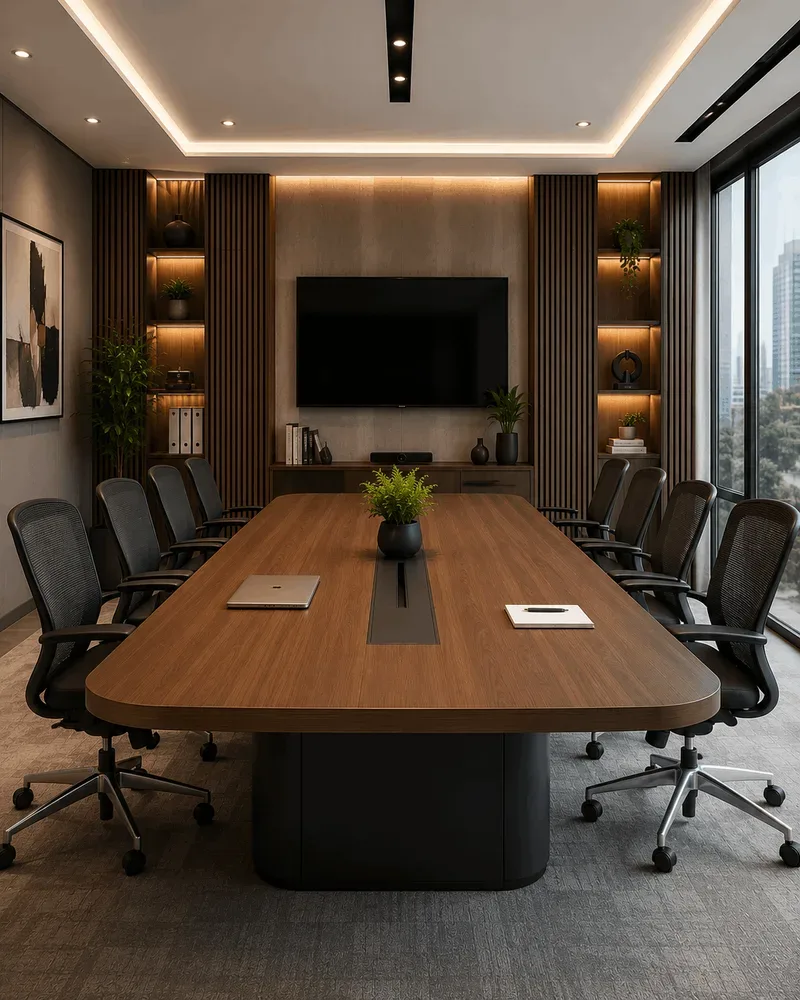
A conference table top or a full-height storage cabinet that does not fit the service lift becomes a staircase problem, and a staircase problem becomes a damage problem. Panel sizes should be checked against the lift car dimensions at the design stage. Ask each bidder when they will measure the lift. If the answer is "on delivery day", you have found the risk.
Loading windows and gate passes
Cyber City, Golf Course Road, MG Road and the Udyog Vihar corridor are full of buildings that restrict daytime material movement, require gate passes filed in advance, or release the loading bay only in a narrow window. None of that is difficult, but it has to be handled before dispatch rather than discovered at the barrier. Fix in writing whose job it is.
Installing around a team that is still working
If the floor is occupied, installation has to be zoned and sequenced, usually by department, with client-facing areas such as reception and the boardroom left until last so nothing visible is half-finished during business hours. Evening, night and weekend windows are normal here and should be in the schedule from the start, not treated as a favour.
Warranty Is the Row That Settles the Rest
There is one practical test for a furniture warranty, and it takes a single question: in year three, when a drawer channel fails or a damaged panel needs matching, which company do we call?
If the answer names one company, you have a warranty. If it involves a seller who will contact a workshop who will contact a hardware brand, you have a sequence of conversations, each of which can stall. The sequence is not necessarily bad faith. It is simply what happens when nobody signed up to own the outcome.
So ask for the warranty duration, the components it covers, the exclusions, and the legal name of the entity issuing it. Check that the name on the warranty matches the name on the invoice. Where the two differ, ask why before the advance goes out.
How to Write Ownership Into the Purchase Order
Procurement language does most of this work, and none of it is unusual to ask for:
Name the single entity responsible for delivery, installation and warranty, even where subcontractors are used
Attach the approved drawing and the specification sheet as annexures, not as email attachments referred to loosely
State the site conditions the supplier has confirmed: lift dimensions, loading window, gate pass process, floor level
Set out the snag process, with a stated number of days for closure after handover
State what the advance covers and what happens to it if the order is cancelled before production
Record who holds the specification for future extension orders, and for how long
Both Models Have a Place
A trading supplier with good workshop relationships can deliver a small order quickly, hold stock you can see today, and take an order without a site visit. For six desks in a serviced office with a hard deadline next week, that may be exactly right.
The manufacturer-direct model earns its place on larger, longer-lived orders: whole floors, specifications that must be repeated when the team grows, and buildings where coordination matters. The trade-off is time, because furniture cut to your measured drawing is not furniture sitting in a warehouse.
Choose by which trade-off suits the order in front of you, and do not let a supplier's description of itself stand in for evidence. Ask where the factory is and whether you can see it.
How Reedify Is Structured
Reedify Modulars manufactures its own product. Every workstation, desk, conference table and cabinet quoted for a Gurgaon office is cut, edge-banded and quality-checked at our 12,000 sq ft factory in Rohtak, roughly 80 km away on the Rohtak-Delhi corridor, and installed by our own team. Design, manufacture, delivery, installation and warranty sit with one company, which is the whole of the argument.
That structure shows up in practical ways. Panel sizes are checked against lift dimensions at the design stage. Loading bay access, lift booking windows and gate-pass requirements are confirmed with your admin team before dispatch. Occupied floors are installed in zones, in evening or weekend windows where the building requires it, and packaging leaves the site the same day. The structural warranty runs up to 10 years*, with terms by component set out on our warranty and service support page, and a service call goes to the company that built the furniture.
The full scope is on our office furniture manufacturer in Gurgaon page, with the product range across all twelve lines on the modular office furniture hub. The stage-by-stage sequence is set out under our working model, and the manufacturing setup on our Rohtak factory page. Companies running offices in more than one NCR city can hold a single specification across sites, including office furniture in Delhi.