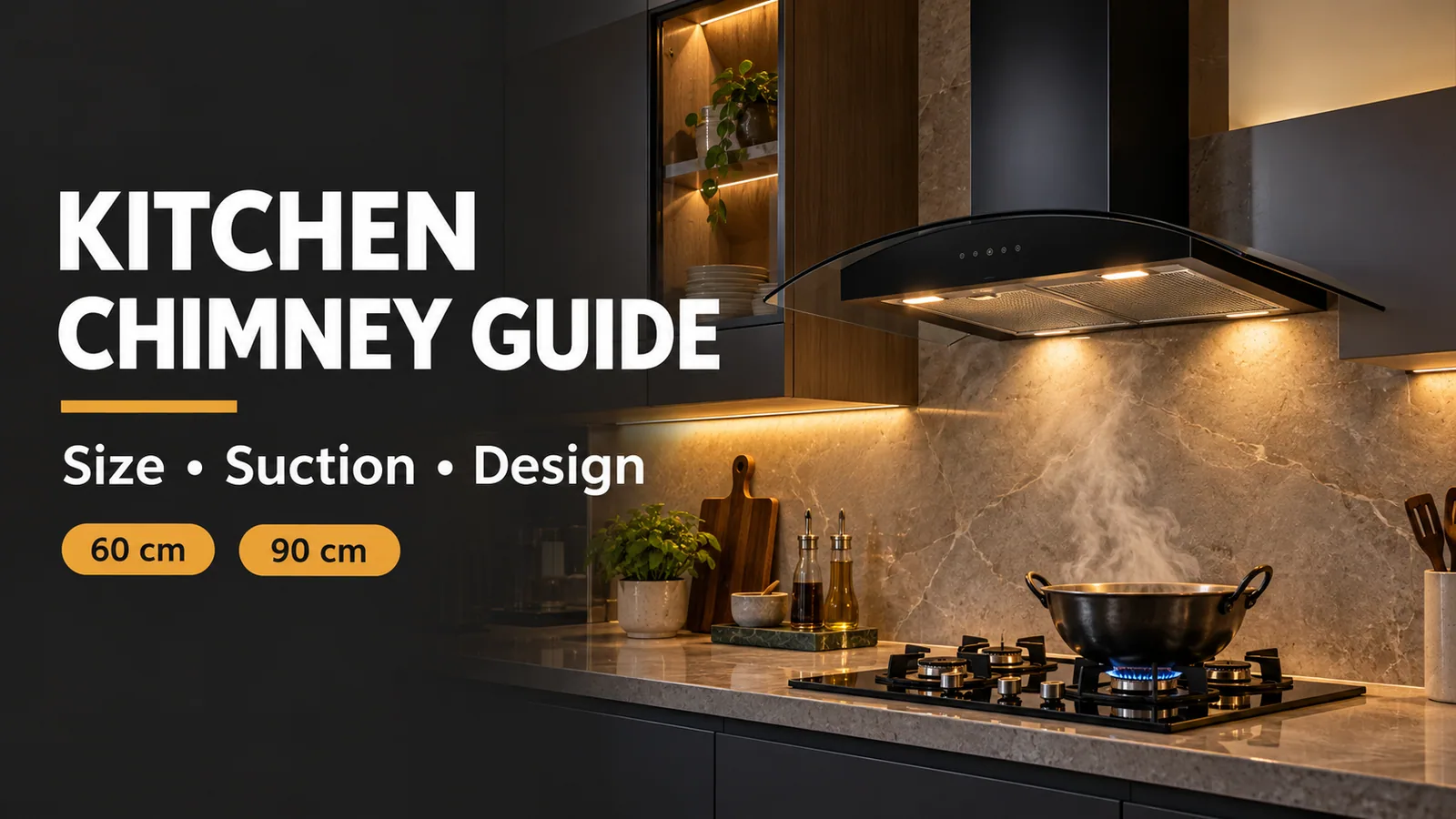
For a modular kitchen, choose a chimney at least as wide as your hob: commonly 60 cm for a two- or three-burner hob and 90 cm for a four- or five-burner hob. For regular Indian cooking, chimney makers commonly suggest a suction capacity of roughly 1,000 to 1,200 m³/h for a 60 cm unit, and more for larger hobs and heavy frying. A ducted chimney with a baffle or filterless auto-clean system, vented through a short duct, performs best. Most importantly, the chimney’s size, height, duct route and power point must be fixed before the wall cabinets are made.
This guide covers chimney types, sizing, suction, filters, ducting, mounting height, design ideas and how to plan the chimney into your modular kitchen.
Key Takeaways
Match the chimney width to the hob, never narrower.
Higher suction helps with tadka and frying, but a long or bent duct reduces real performance.
Baffle filters and filterless auto-clean chimneys suit oily Indian cooking better than mesh filters.
Ducted chimneys remove smoke far better than recirculating ones.
Wall cabinets beside the chimney are sized around its mounting height.
Types of Kitchen Chimneys
Type | Where it fits | Best for |
|---|---|---|
Wall-mounted | Against the wall above the hob | Most Indian kitchens |
Island chimney | Hung from the ceiling above an island hob | Island kitchens; needs a ceiling duct route |
Built-in or integrated | Concealed inside a wall cabinet | Clean, minimal kitchens |
Corner chimney | Shaped for a corner hob | Kitchens where the hob sits in a corner |
Downdraft | Rises from the counter behind the hob | Premium open kitchens; less common in India |
Chimney Size: Match It to Your Hob
Hob | Common chimney width | Note |
|---|---|---|
2 burners | 60 cm | Covers a compact hob |
3 burners | 60 or 75 cm | Choose wider if you cook heavily |
4–5 burners | 90 cm | Full coverage of outer burners |
A chimney narrower than the hob lets smoke escape from the outer burners. If in doubt, choose the wider size.
Suction Capacity for Indian Cooking
Suction is stated in cubic metres per hour (m³/h). Indian cooking, with tempering, frying and long simmering, needs more suction than lighter cooking. Chimney makers commonly suggest about 1,000 to 1,200 m³/h for regular cooking with a 60 cm chimney, and higher capacity for 90 cm chimneys and heavy frying. Two practical points matter as much as the number:
A short, straight duct delivers close to the rated suction; every extra bend and metre reduces it.
Very high suction can be noisy. In open kitchens, check the noise level as well as the suction figure.
Chimney Filters: Baffle, Filterless and Mesh
Filter type | How it works | Consider |
|---|---|---|
Baffle filter | Stainless steel panels change the airflow direction so oil separates out | Well suited to Indian cooking; wash periodically |
Filterless with auto-clean | Oil collects in a removable cup; a heating cycle loosens deposits | Less cleaning; empty the oil collector |
Mesh filter | Layers of aluminium mesh trap grease | Clogs faster with oily cooking; needs frequent cleaning |
Carbon filter | Absorbs odour in recirculating chimneys | Needs replacement; used only where ducting is impossible |
Ducted vs Ductless Chimneys
A ducted chimney pulls smoke through a pipe and vents it outside. A ductless or recirculating chimney filters the air and returns it to the room. For daily Indian cooking, ducted is clearly more effective at removing smoke, heat and smell. Use ductless only where an external duct is truly impossible.
Planning the duct
Keep the duct as short and straight as possible, with as few bends as you can.
Match the duct diameter to the chimney’s outlet size on the spec sheet.
Plan the route before tiling and before the wall cabinets are drawn, since the duct often runs above or through them.
In apartments, check whether an external wall opening is allowed or a duct outlet already exists.
Chimney Height Above the Hob
Most chimney manufacturers specify a mounting height of roughly 65 to 75 cm above a gas hob. Follow the figure in your model’s installation manual, because it decides how high the wall cabinets on either side can start. For all kitchen heights and clearances, see our modular kitchen dimensions guide.
Modular Kitchen Chimney Design Ideas
Curved or angled glass chimney: gives head clearance over the hob and a modern look.
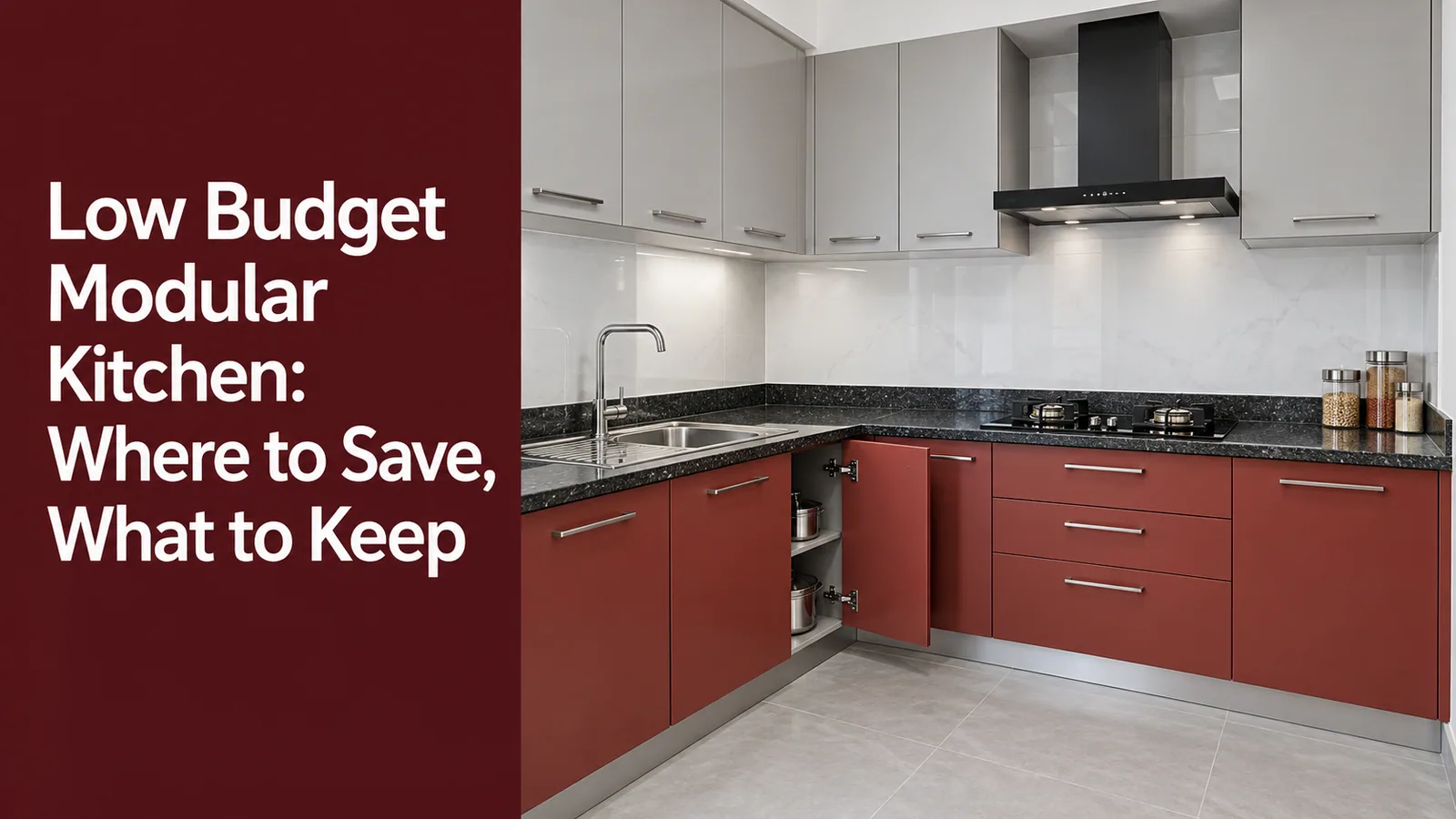
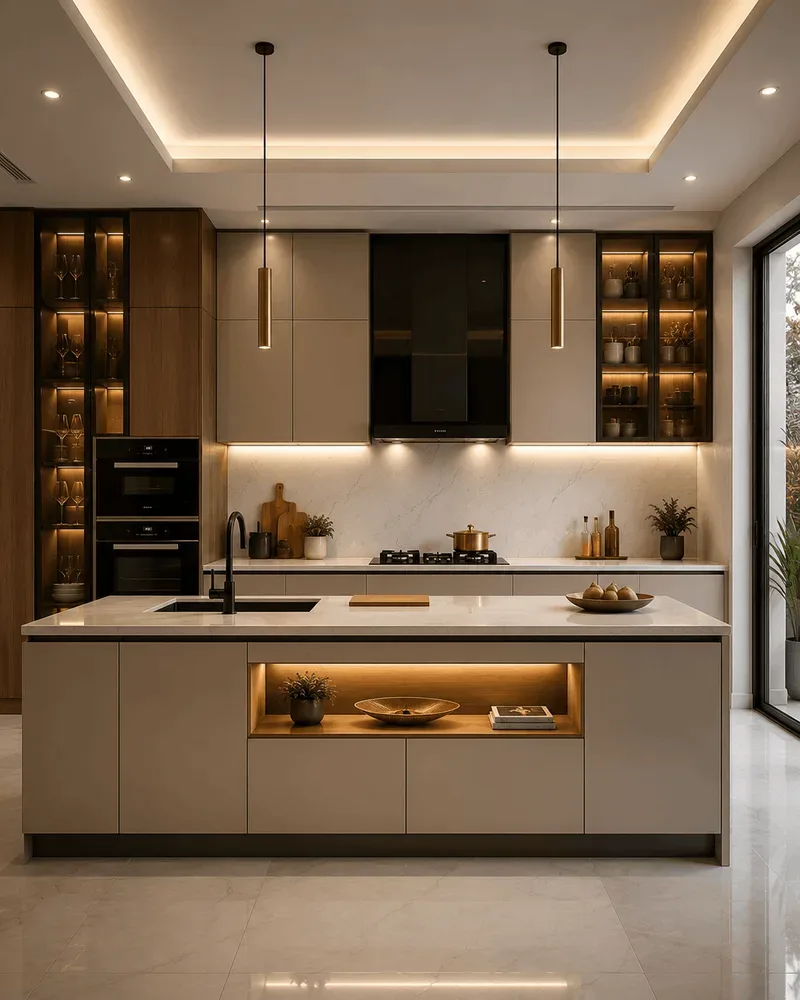
Black or dark glass: pairs well with handleless and dark cabinets and hides fingerprints.
Built-in chimney inside a wall cabinet: keeps a clean line of cabinets for minimal kitchens.
Matching side wall units: wall units on either side aligned to the chimney’s height for a framed look.
Full-height backsplash behind the hob: stone or tiles that are easy to wipe.
Under-cabinet lighting on both sides: keeps the counter lit beside the chimney’s own light.
Planning the Chimney Into Your Modular Kitchen
Choose the hob first, then a chimney at least as wide.
Shortlist chimneys by suction, filter type and noise level.
Fix the mounting height from the installation manual.
Plan the duct route and confirm any society permission.
Place a power socket high on the wall, hidden behind the chimney cover.
Size the adjacent wall units around the chimney before production.
In an open kitchen, extraction matters even more. Our guide to open kitchens in Gurgaon apartments explains chimney choice when the kitchen faces the living room.
Chimney Noise, Energy and Everyday Comfort
A chimney you find too loud is a chimney you stop using. Check the noise level the manufacturer quotes in decibels, especially for open kitchens, and look for multiple speed settings so you can run it quietly during light cooking and at full speed only for frying and tadka. Motors with variable speed control can also use less electricity at lower speeds. Touch or gesture controls look sleek, while push buttons are easier to use with oily fingers.
Chimneys for Island and Open Kitchens
An island chimney hangs from the ceiling and draws smoke from all sides, so it usually needs more suction than a wall chimney of the same width. Its duct must run through the ceiling, which means planning it with the false ceiling before construction. In open kitchens, keep the hob on a wall where possible, choose a quieter model, and run the chimney before you start cooking so smoke is captured before it reaches the living area.
Cleaning and Maintenance
Wash baffle filters regularly with warm water and mild detergent.
Empty the oil collector on filterless models when it fills.
Wipe the glass and body after heavy cooking to stop grease building up.
Run the chimney for a few minutes after cooking to clear remaining smoke.
Chimneys in a Reedify Kitchen
Reedify Modulars manufactures every kitchen in its own factory in Rohtak. We plan the wall units, duct route and power point around the chimney you choose, using its installation sheet, before any panel is cut. To plan the cooking zone in your custom modular kitchen, share your hob and chimney choice with our team.