

A modular wardrobe is one of the larger fixed purchases in a home, and unlike a sofa you can't return it if the internal layout doesn't work. The choice that decides how it turns out is made early — which modular wardrobe manufacturer you hand the project to. This guide breaks down what that decision actually involves: what a manufacturer is (and isn't), the seven things worth verifying before you sign, how to pick between sliding, hinged and walk-in, and what really moves the price. It's written from the factory side, so it focuses on the things that are easy to miss until the wardrobe is already installed.
What a “Modular Wardrobe Manufacturer” Actually Is (and What It Isn't)
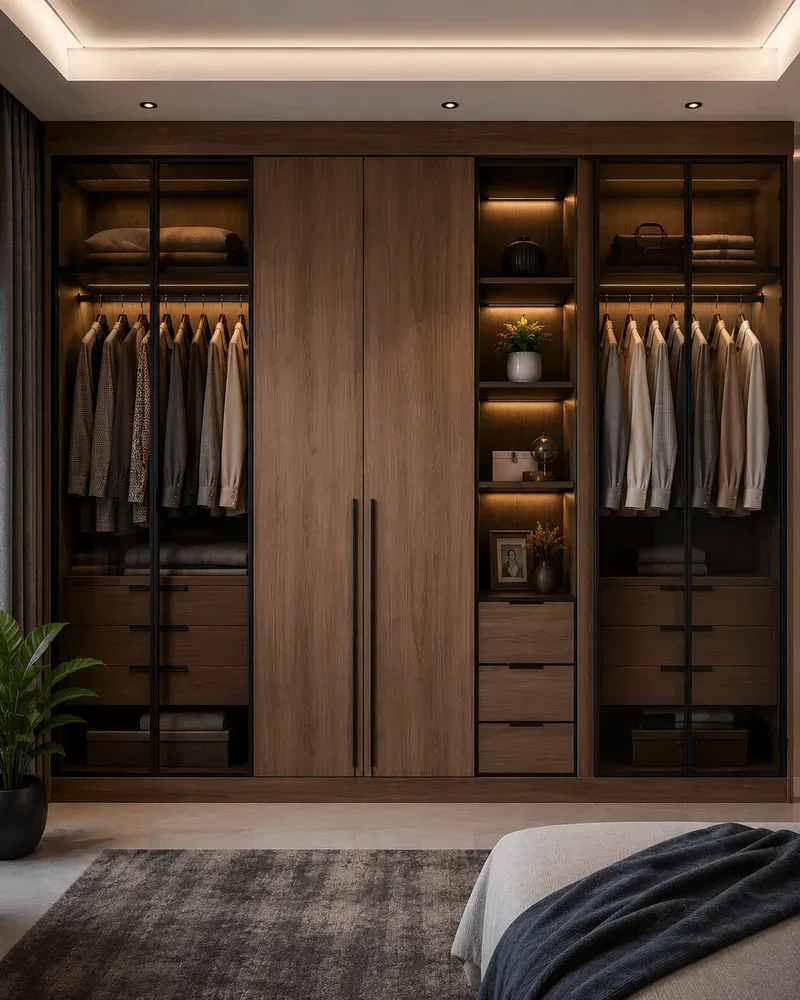
A modular wardrobe is a factory-made storage system: measured panels, shutters, shelves, drawers, hanging sections and accessories that are planned in full before anything is cut, then assembled on site. A modular wardrobe manufacturer is the party that physically makes those panels. That sounds obvious, but the word gets used loosely, and four very different kinds of businesses all advertise under it:
A local carpenter builds the wardrobe in place, on your wall. Flexible and low-cost, but panel accuracy, edge finishing and finish consistency depend entirely on one person's hand and the conditions on site.
A design studio is strong on styling and 3D visuals, but the wardrobe itself is usually outsourced to a third-party workshop. You're paying for design plus a coordination margin.
A reseller or dealer books your order and passes it to a factory you never see, adding a margin on top of the factory's price.
A factory-direct manufacturer measures, designs, cuts and edge-bands in its own unit and installs with its own team. There's no reseller margin, and one company is accountable end to end.
The distinction matters because the party that physically manufactures your wardrobe controls the three things you'll live with: how accurately the panels are sized, how cleanly the edges are finished, and what you pay. Reedify Modulars sits in the last group — it manufactures in its own Rohtak factory and supplies direct, which is worth stating only because it changes what you should ask for.
The Seven Things to Verify Before You Sign
Most wardrobe regret traces back to a detail that was never confirmed in writing. These are the seven worth pinning down before you pay an advance.
1. Who actually manufactures it
Ask directly: do you own the factory, or is production outsourced? This one answer tells you whether there's a dealer margin in your quote and who you'll chase if a panel arrives wrong. A factory-direct maker removes the middle layer and keeps accountability in one place.
2. Board and carcass material
The carcass is the box everything hangs on, and it decides how the wardrobe ages. The two common choices are plywood and HDHMR. Plywood is strong and handles load and some moisture well; HDHMR gives a very smooth, uniform surface that takes finishes cleanly. Reedify offers both as base materials — the right one depends on load, moisture exposure in the room and budget, so ask which board is quoted and why, not just the shutter colour.
3. Hardware — hinges, channels and soft-close
Hardware is the part of a wardrobe you physically touch every day, and it's where corners get cut quietly. Soft-close hinges and channels are the difference between shutters and drawers that glide shut and ones that bang after a year. Ask which hardware brand and grade is in the quote, and whether soft-close is included or an add-on. Get the answer in writing — “premium hardware” on a quotation means nothing without a name.
4. Shutter finish
The finish sets both the look and how the wardrobe wears. Reedify's wardrobe finishes are laminate, acrylic, PU, glass, mirror and wooden-texture. As a rough guide: laminate is the durable, practical, best-value option with the widest range of designs; acrylic gives a high-gloss modern face that wipes clean; PU is a smooth painted finish for a seamless handleless look; glass and mirror suit display and dressing zones. There's no single “best” — match the finish to how much daily handling and cleaning the wardrobe will get.
5. A 3D design before anything is produced
You should be able to see the exact unit in 3D — internal layout, shutter style, finish and storage zones — and approve a fixed, itemised quote before a single panel is cut. This is the stage where you catch a hanging section that's too short or a drawer that will foul the bed. If a manufacturer wants an advance before showing you a design and a locked price, treat that as a warning.
6. Who installs it
A well-made wardrobe can still be handed over badly if installation is farmed out to whoever is free that week. Ask whether the same company's own team installs, or a freelance fitter. An in-house team that follows the approved drawing is what keeps alignment, gaps and final fitment consistent — and it means one accountable party if something needs correcting.
7. Warranty on paper
Warranty on a modular wardrobe isn't one flat number — it depends on the board, the hardware and the specific brand or company terms behind each. What matters is that it's written down before you finalise, not described verbally. Reedify explains applicable warranty support based on the board, hardware and finish you choose, up to 10 years*, so expectations are clear at the quote stage rather than after installation.
Sliding, Hinged or Walk-In: A Quick Decision
Wardrobe type is usually decided by the room, not by preference. The table below is the short version; the sliding wardrobe, hinged wardrobe and walk-in wardrobe options each go deeper.
Type | Best for | Space it needs | Main watch-out |
|---|---|---|---|
Sliding | Small or narrow bedrooms; rooms where the bed sits close to the wardrobe wall. | No door-swing clearance needed — shutters slide within the frame. | Usable depth is slightly reduced by the sliding track; two shutters can't both be open at once. |
Hinged | Full front access and a classic look; usually the most budget-friendly per foot. | Needs clear swing space in front of each shutter. | Won't suit tight walkways or a bed placed close to the wardrobe. |
Walk-in | A separate dressing area or a large master bedroom with a spare corner. | Needs a dedicated zone, not just a wall. | Only makes sense when floor area is genuinely available. |
The most common real-world call is sliding versus hinged, and it comes down to floor space. If the bed or a walkway sits close to the wardrobe wall, sliding usually wins because there's no swing clearance to lose. If the room can spare the swing space, hinged gives you full front access and typically costs less per running foot.
What Actually Drives Modular Wardrobe Price
There's no honest fixed price for a wardrobe, because two units of the same width can cost very differently. What moves the number is specific and worth understanding before you compare quotes:
Size and type — sliding, hinged, walk-in and full master layouts use different panel lengths and material quantities.
Shutter and finish — laminate, acrylic, PU, glass, mirror and wooden-texture differ in look, maintenance and cost.
Board material — plywood, HDHMR and other boards affect strength, moisture suitability and price.
Internal layout and hardware — drawers, hanging sections, soft-close hinges, channels and accessories change the estimate more than most people expect.
Mirror, glass, loft and extras — mirror or glass work, loft storage, lighting and installation complexity all add to scope.
This is why a trustworthy quote comes after a room measurement and a storage discussion, not as a per-square-foot figure over the phone. If a number arrives before anyone has measured your wall, it's a guess.
A Note for Delhi NCR Buyers
Location changes the wardrobe more than people assume. Newer builder-floor and high-rise flats across Gurgaon and Noida often have fixed beam positions, shallower bedrooms and beds placed close to the wardrobe wall — which is exactly where sliding shutters earn their place. Many older Delhi homes have deeper rooms and taller ceilings, where a hinged layout with a loft section for suitcases and seasonal bedding uses the height well. Reedify serves Haryana and the wider Delhi NCR from its Rohtak factory, planning each unit around the specific room rather than a standard size, so the layout decision is made against your actual wall — not a catalogue.
If you're weighing a full bedroom fit-out, it's worth planning the wardrobe alongside other built-ins early; the same logic that applies here is covered for kitchens in Reedify's L-shaped modular kitchen guide.


