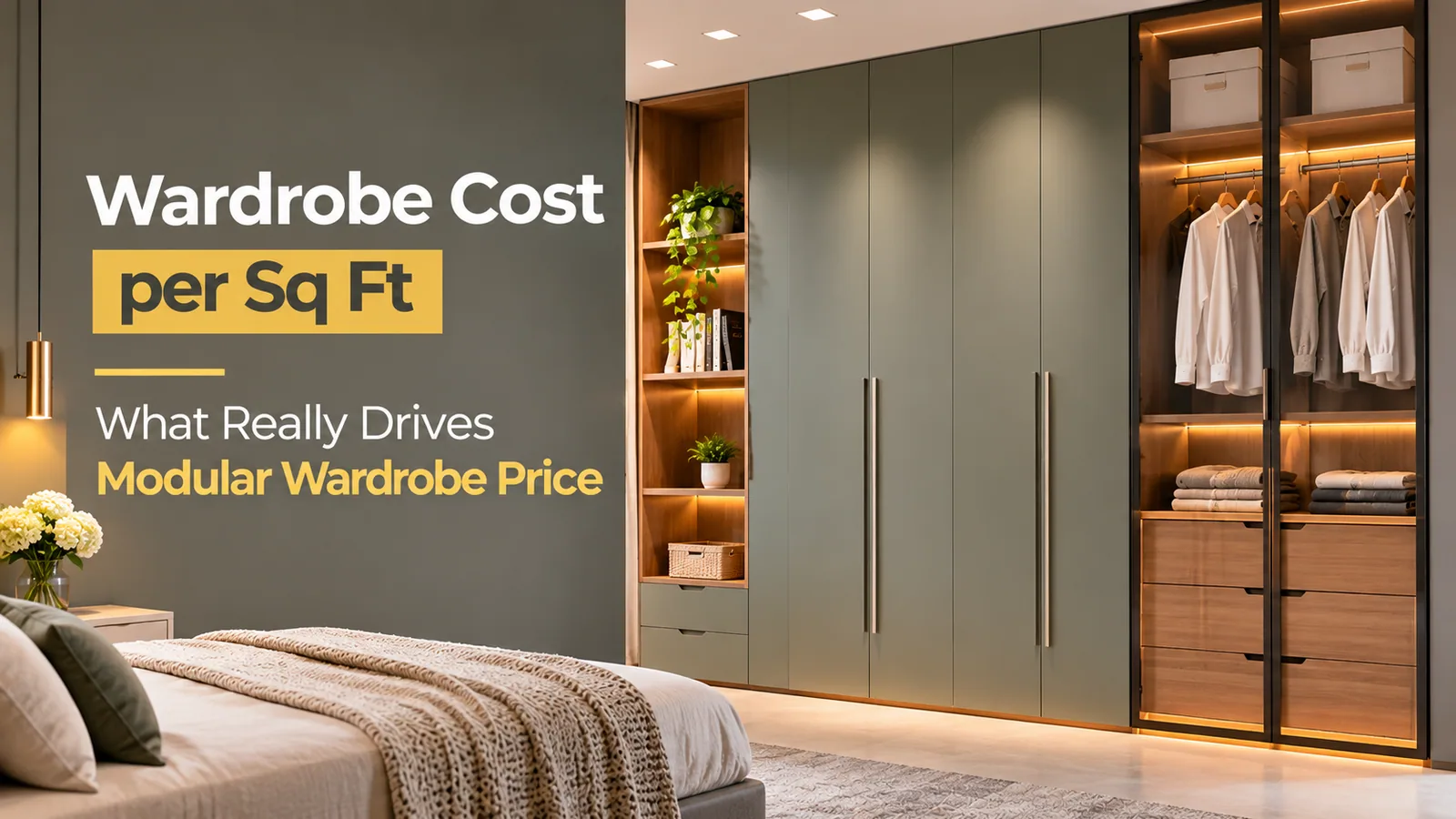
At Reedify Modulars, a modular wardrobe starts at ₹1,200 per sq ft, plus GST. The square footage is the front area of the wardrobe: its width multiplied by its height, including the loft if you have one. From that starting rate, the price moves up with the board, the shutter finish, the hardware and the fittings you put inside.
Ask three companies for a wardrobe price and you'll often get three very different numbers for what looks like the same cupboard. That isn't always overcharging. Two wardrobes of the same width can genuinely cost very differently depending on what is inside and on the surface. This guide shows how the area is worked out, what common sizes cost from, and how to compare two quotes properly.
How wardrobe cost per sq ft is calculated
Measure the wardrobe width in feet.
Measure the height from the floor to the top of the wardrobe, or to the top of the loft if the loft is included.
Multiply width by height to get the front area in sq ft.
Multiply that area by the rate for the board, finish and hardware you choose.
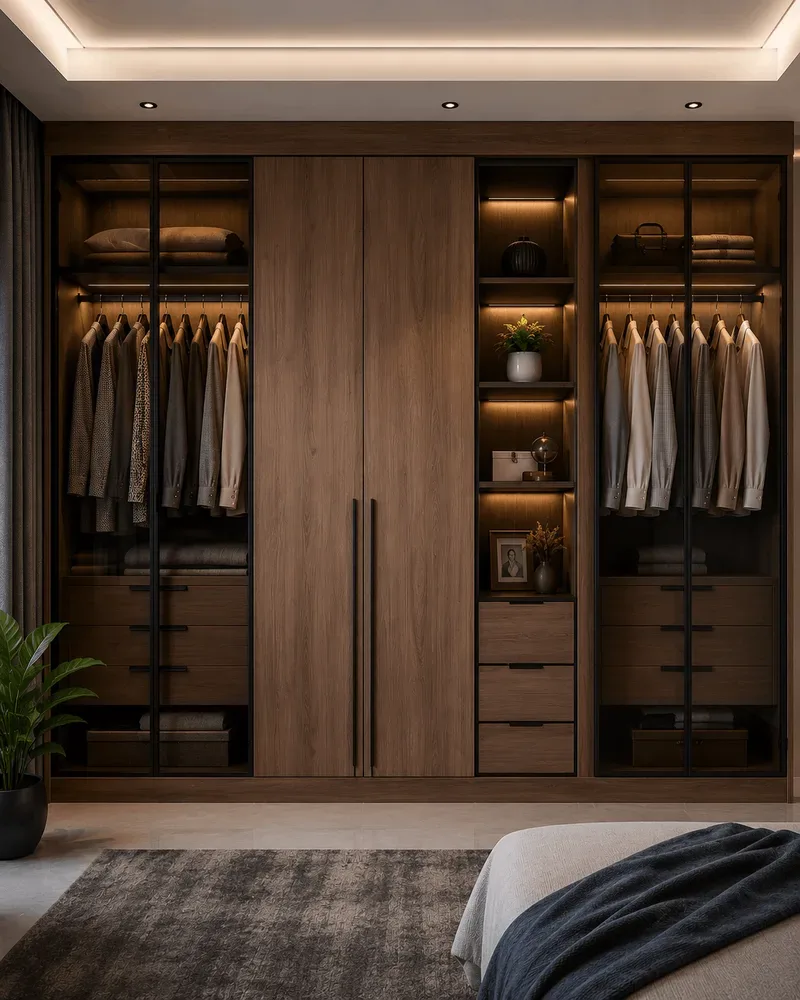
The rate covers the carcass, shutters and the hardware fitted in the factory. Internal fittings such as extra drawers, pull-out trays and organisers, mirrors, glass and lighting add to it.
What common wardrobe sizes cost from
These are starting prices at Reedify's base rate of ₹1,200 per sq ft, before GST. Your final price depends on the specification you approve.
Wardrobe | Size (W × H) | Front area | From (before GST) |
|---|---|---|---|
2-door hinged | 4 ft × 7 ft | 28 sq ft | ₹33,600 |
3-door hinged | 6 ft × 7 ft | 42 sq ft | ₹50,400 |
4-door hinged | 8 ft × 7 ft | 56 sq ft | ₹67,200 |
3-door with loft to 9 ft | 6 ft × 9 ft | 54 sq ft | ₹64,800 |
Full wall with loft | 10 ft × 9 ft | 90 sq ft | ₹1,08,000 |
A walk-in wardrobe is not priced this way, because it is a set of open and closed units around a room rather than one front. It is quoted unit by unit on the design.
What moves the price above the starting rate
Cost driver | Why it changes the price |
|---|---|
Size and type | More area means more material; sliding, hinged and walk-in use different quantities |
Board / carcass | Plywood and HDHMR differ in cost, strength and moisture behaviour |
Shutter finish | Laminate, acrylic, PU paint, painted gloss and glass sit at different price and upkeep levels |
Hardware | Soft-close hinges, channels, sliding tracks and the brand grade change the number |
Internal fittings | Extra drawers, pull-outs, organisers and hanging sections each add cost |
Mirror, glass, loft | Mirror or glass work, loft storage and lighting add scope |
Installation | Uneven walls, high lofts and site conditions affect installation effort |
The carcass you don't see
The board behind the shutter is where a low quote often hides. Plywood and HDHMR are the two common carcass materials, and they differ in strength, screw-holding and how they handle moisture. A cheaper wardrobe sometimes uses a thinner or lower-grade board, which you won't notice on day one but will after a few years of load. Always ask which board is quoted, not just the shutter colour. The wardrobe materials and finishes guide compares them.
Finish: look versus upkeep
Laminate is the durable, best-value finish with the widest range of designs. Acrylic gives a high-gloss face that wipes clean. PU paint and painted gloss give a smooth, continuous look that suits handleless designs. Glass and mirror suit dressing and display zones. There is no single best finish, only the right match for how much daily handling the wardrobe gets and what you want to spend.
Hardware: where quiet cost-cutting happens
Hinges and channels are the parts you touch every day, and they are the easiest place to shave a quote without it being obvious. Reedify fits Hettich and Häfele hardware and writes the brand and grade on your quotation. A quote that says only "premium hardware" without naming the brand is worth questioning.
Sliding versus hinged
For the same width, a sliding wardrobe usually costs more than a hinged one, because of the track system and the heavier, wider shutters. Choose sliding when there is too little space in front of the wardrobe for doors to swing. The sliding vs hinged wardrobe guide covers the trade-offs.
Why factory-direct changes the number
A large part of many wardrobe prices is margin stacked between the factory and you: dealers, coordinators and resellers. Reedify manufactures in its own Rohtak factory and supplies direct, so the modular wardrobe price you approve is the factory price for your chosen board, finish and hardware, not a marked-up version of it.
How to compare two wardrobe quotes fairly
Is the price per sq ft applied to the same area (with or without the loft)?
Is the same board (plywood or HDHMR) and thickness quoted in both?
Is the hardware brand and grade named, and is soft-close included or extra?
Is it the same finish, and the same finish grade, on both?
Are all the internal fittings you want (drawers, pull-outs, loft) in the price, or added later?
Is installation included, and is the warranty written down?
A quote that spells these out is almost always more trustworthy than a lower one that doesn't. Warranty in particular should be on paper. Reedify's own cover on panels and workmanship runs up to 10 years*, and the exact term depends on the board grade on your quotation. If you are designing from scratch, a custom wardrobe is quoted to your exact design rather than a standard size.