
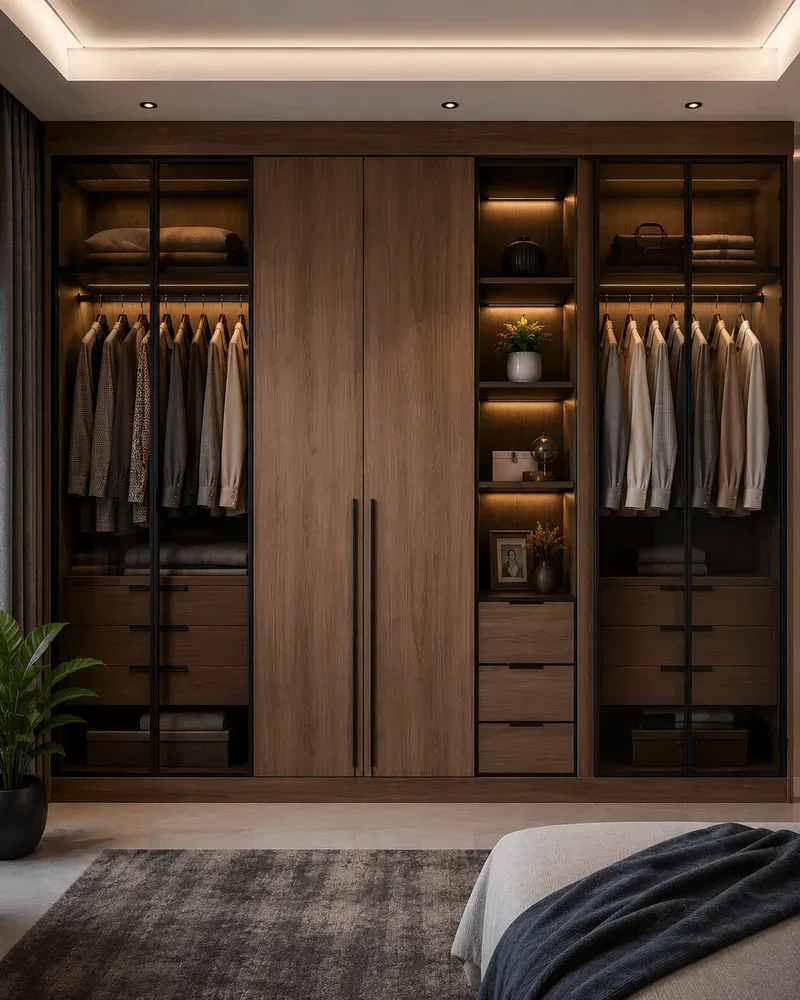

Almost every wardrobe project starts with the same fork in the road: sliding shutters or hinged doors. It gets treated as a style choice, but in most homes it's really a floor-space decision, and getting it wrong is expensive to undo. This is a straight comparison of the two, from the side that builds them.
The difference in one line
A hinged wardrobe has doors that swing outward on hinges, so you need clear space in front of it. A sliding wardrobe has shutters that glide sideways within the frame, so it needs no swing clearance at all. Everything else, price, access, ventilation, follows from that one mechanical difference.
Sliding vs hinged at a glance
Factor | Sliding | Hinged |
|---|---|---|
Floor space needed | None in front; shutters stay within the frame | Clear swing space in front of every door |
Access | Only part is open at once | Full front opens; you see everything together |
Cost tendency | Usually a bit higher (track and roller system) | Usually the most budget-friendly per foot |
Best room | Small or narrow rooms; bed close to the wall | Rooms with space to open doors fully |
Upkeep | Bottom track needs occasional cleaning | Hinges may need tightening over years |
When a sliding wardrobe is the right call
Sliding wins whenever floor space is tight. If the bed, a walkway or another piece of furniture sits close to the wardrobe wall, hinged doors simply won't have room to open, whereas sliding shutters never intrude past the frame. They also suit long wardrobe runs and, with a mirror shutter, double as a full-length mirror without adding a separate one. The trade-off to accept: with two shutters, only half the wardrobe is open at any moment, so the internal layout should keep everyday items reachable from both sides.
When a hinged wardrobe wins
If the room can spare the swing space, a hinged wardrobe is often the better buy. You get full front access, so you see the whole interior in one go, it usually costs less per foot, and the inside of the doors becomes usable surface for mirrors, tie racks and hooks. Hinged units also ventilate a little better, which matters in humid conditions. The only real cost is the floor area the open doors demand.
The points people miss
With sliding, the two shutters can never both be open at once, plan the interior so daily-use sections aren't hidden behind a fixed panel.
Hinged doors need real clearance, measure the gap to the bed before committing, not just the wall width.
Soft-close is available on both, insist on it in writing; it's the difference between shutters that glide and ones that bang.
For a very wide wall, a mix works: sliding for the main run and a hinged section for the corner.
What it means for your quote
Both types are built to the same measured design in Reedify's own Rohtak factory and installed by its team, so the honest way to decide is to have the room measured first and see the layout in 3D before locking anything. Warranty support depends on the board, hardware and brand terms you choose and can extend up to 10 years*. If you're weighing the wider decision, the modular wardrobe options page shows how each type is planned.


