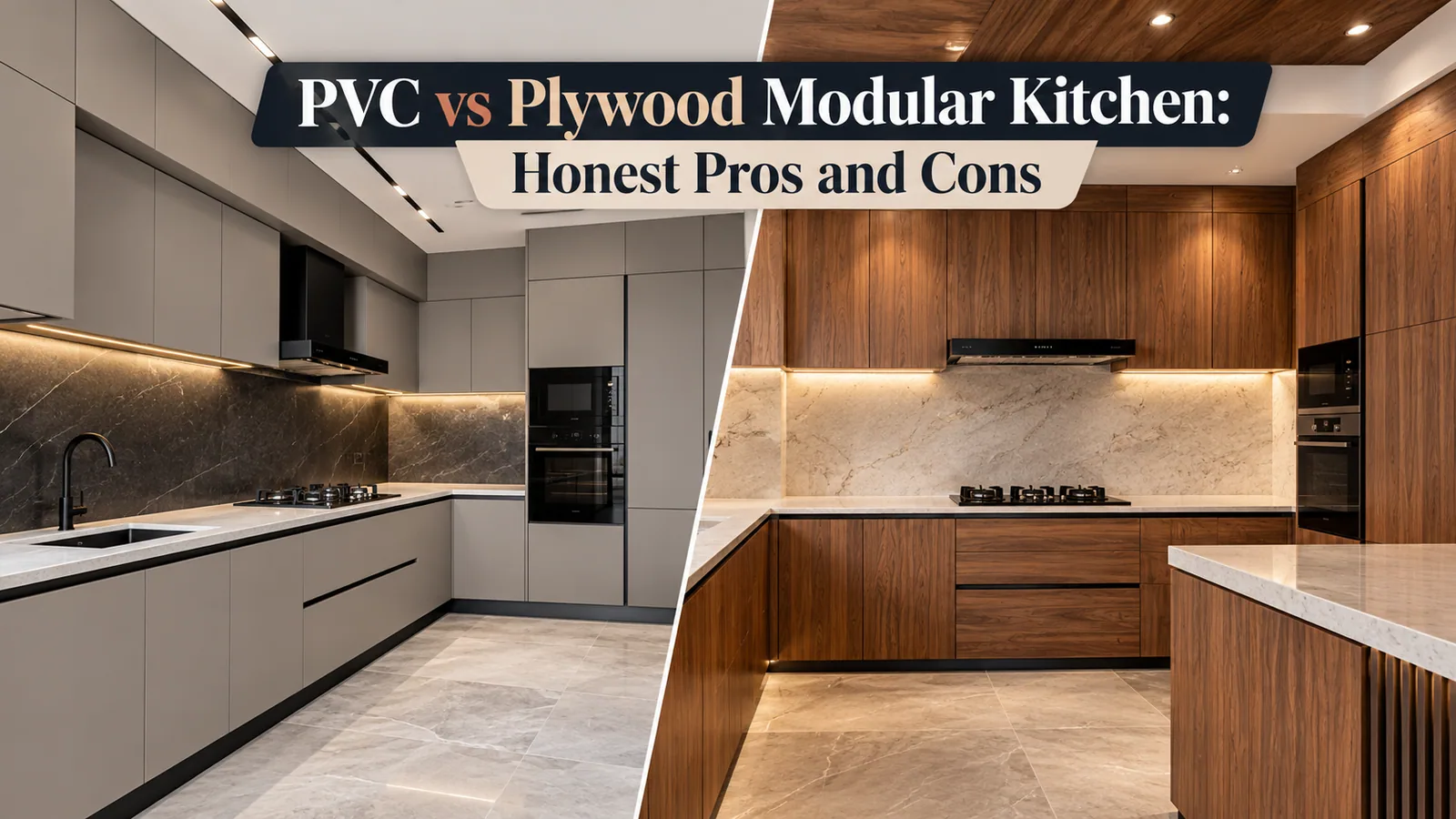
PVC kitchen cabinets do not swell with water and termites do not eat them, which makes them attractive for the wettest parts of a kitchen and for tight budgets. Plywood is stronger, holds screws better, handles heat near the hob better and looks more like furniture. For most Indian kitchens, the practical answer is not one or the other everywhere. It is choosing by zone, and knowing which kind of PVC board you are being offered.
Online advice on PVC is unusually contradictory. Some pages call it waterproof and fire retardant; others call it unsafe for kitchens. This guide sets out what is actually true, what depends on the product, and where each material makes sense.
What a PVC Kitchen Actually Is
A PVC kitchen uses boards made from polyvinyl chloride instead of wood-based board for the cabinet boxes and sometimes the shutters. The type of board matters more than the word “PVC”:
Solid or foam PVC board is a dense sheet that is rigid enough for cabinets when thick enough.
Hollow PVC board has internal channels. It is lighter and cheaper but weaker, especially for shelves and fixings.
uPVC is unplasticised PVC, a harder form used for some kitchen profiles and boards.
Always ask which board type and thickness is quoted. Two “PVC kitchens” can perform very differently.
PVC vs Plywood Compared
Factor | PVC board | Plywood (good grade) |
|---|---|---|
Water | Does not absorb water or swell | Depends on grade; BWR or BWP resists water well when edges are sealed |
Termites | Not affected | Depends on treatment |
Heat near the hob | Can soften or deform with sustained heat; keep away from direct hob heat | Handles kitchen heat better |
Strength and load | Lower; long shelves can sag under heavy vessels | Higher; suits heavy drawers and shelves |
Screw holding | Weaker, especially hollow board | Strong, suits hinges and channels |
Look | Can look plastic; limited finish options | Takes laminate, acrylic, PU paint and more |
Colour over time | Some boards can yellow or fade with sunlight | Finish-dependent |
Cost | Usually lower | Usually higher |
For the full range of boards and grades, see our modular kitchen materials guide.
Common Myths on Both Sides
Claim | The honest answer |
|---|---|
“PVC is completely indestructible.” | It resists water and termites, but it dents, can sag under load and does not like sustained heat. |
“PVC is fire-proof.” | No board is fire-proof. Some PVC boards have fire-retardant properties; ask for the product’s specification rather than assuming. |
“PVC is unsafe in any kitchen.” | Used away from direct hob heat, PVC cabinets are widely used in Indian kitchens. The sensible precaution is to keep it out of the hob zone. |
“Plywood always swells.” | Low-grade or unsealed plywood can. A water-resistant grade with sealed edges handles a kitchen well. |
“Plywood is always better.” | Under a leaking sink, water-resistant PVC can outlast poorly specified plywood. |
Where PVC Makes Sense in a Kitchen
The sink base, where water exposure is highest.
Utility areas, washing-machine niches and balconies.
Budget or rental kitchens where a short-to-medium life is acceptable.
Homes with a history of termites.
Where Plywood Is the Better Choice
The hob base and any cabinet close to heat.
Heavy-vessel drawers and long shelves.
Tall units and wall units carrying weight.
Kitchens where you want acrylic, PU paint or a furniture-like finish.
A Practical Mix: PVC Where It Is Wet, Plywood Elsewhere
Many homeowners combine materials: water-resistant board or PVC under the sink, and a good grade of plywood or HDHMR for the rest of the kitchen. If you want steel in the wettest zones instead, a stainless steel sink base is another option. Whatever you choose, sealed edges and correct fixings matter as much as the board.
What to Ask Before You Buy a PVC Kitchen
Is the board solid or foam PVC, or hollow?
What is the thickness for the carcass, shelves and shutters?
Which parts, if any, sit near the hob, and what is used there instead?
How are hinges and channels fixed, and what load are the drawers rated for?
What finish is on the shutters, and how does it hold up to sunlight?
Is the board type and thickness written on the quote?
How Reedify Handles Material Choice
Reedify Modulars manufactures at its own factory in Rohtak and works with the board type and brand you choose, including PVC and plywood, rather than limiting you to one material. We recommend what suits each zone of your kitchen and write your final choice on the itemised quote. To discuss the right mix for your custom modular kitchen, share your floor plan with our team. For how board choice affects a quote, see our guide to comparing kitchen quotes.