
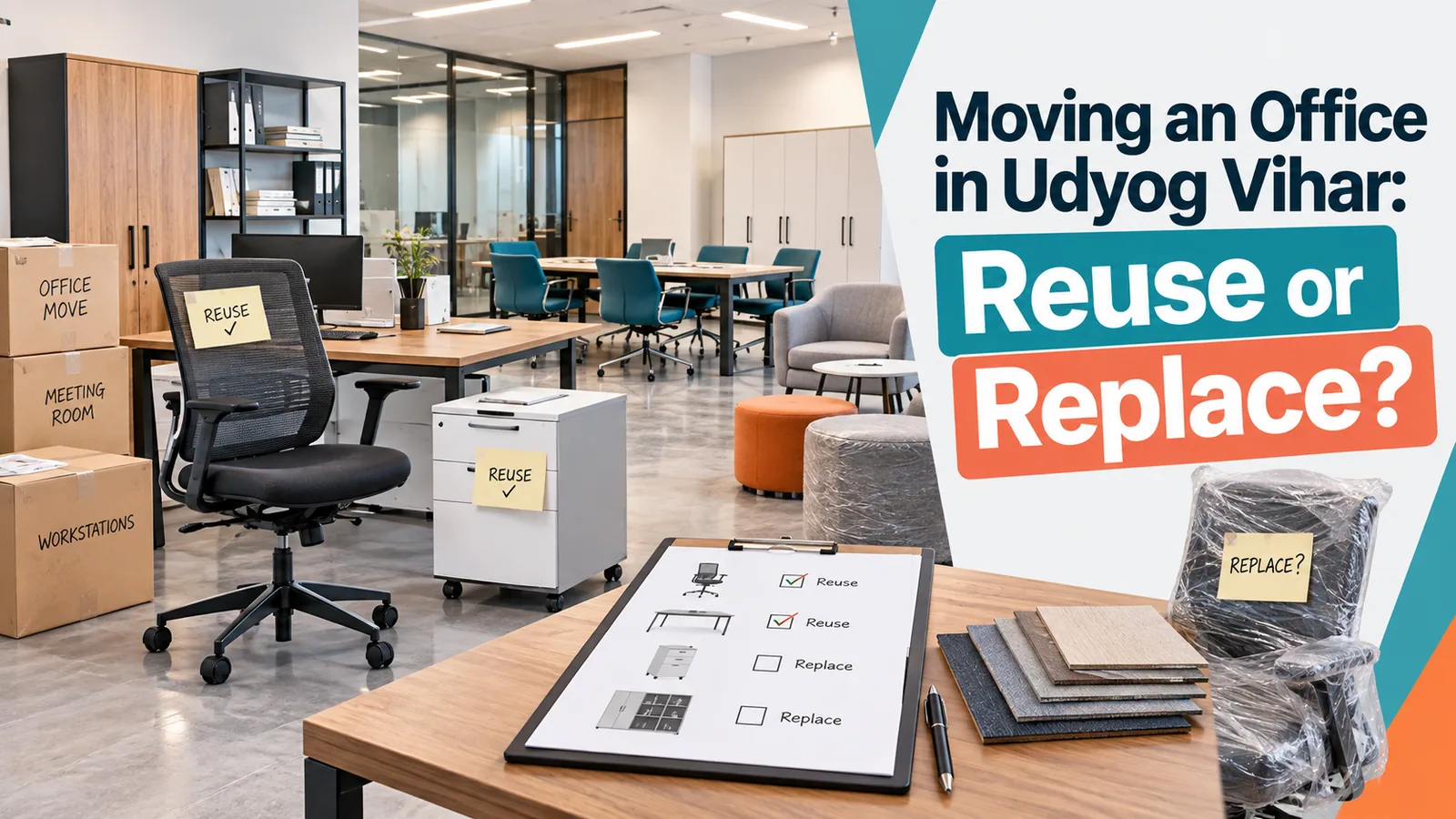
An office move in Udyog Vihar usually starts with a new floor plan and a quotation for new furniture. It should start with a walk around the old office holding a notepad, because a good share of what you already own will work in the new space, and a good share of it will not, and nobody can tell which is which from memory.
The aim of this article is a decision you can defend: every item sorted into reuse, resize, replace or dispose, with a reason written next to it, before a single new unit is ordered.
Do the Inventory Before the Quotes
Walk the existing office and record every furniture item with four pieces of information: what it is, its overall size in millimetres, its condition, and whether it comes apart. Photograph each type once, including the underside and a joint.
That last column, whether it comes apart, is the one people forget and the one that decides the move. A knock-down unit with visible fixings can usually be dismantled, transported and reassembled. A unit that was glued, pinned or built in place usually cannot, or can only be moved once.
While you are there, note the things that will not appear on any inventory but will affect the plan: which pedestals still lock, which drawer channels have started to drag, which worktops have lifted edges, and how many units are actually in daily use versus quietly storing junk.
Four Outcomes, and the Test for Each
Every item lands in one of four buckets.
Reuse as is. The unit is structurally sound, it dismantles, and it fits the new layout without modification. Reuse is the cheapest outcome and the one to test for first.
Resize or modify. The unit is sound but the wrong size for the new floor, or needs a new cut-out, a different partition height, or a replacement top. Worth exploring, but with a caution below.
Replace. The unit is sound but does not fit the new plan and cannot sensibly be altered, or it is at the end of its working life, or it will not match the units you are adding.
Dispose or redeploy. Storage that holds nothing anybody needs, and units in poor condition that would cost more to move than to replace. Moving furniture you do not use is one of the more reliable ways to overspend on a relocation.
A Decision Sequence You Can Run in an Afternoon
Take each item type and run it in this order. Stop at the first failure.
Does it dismantle without damage? If no, it is replace or dispose. Nothing after this matters.
Is the structure sound, with no swelling at the base, no lifted edges, no racking when pushed laterally? If no, replace.
Does it fit the new layout with no modification? If yes, reuse and move on.
Can it be altered to fit, and is the alteration worth the cost of the labour plus the move? If no, replace.
Will it sit next to new furniture? If yes, check finish, height and hardware compatibility before deciding to reuse.
That last check is the one that quietly ruins otherwise sensible relocations. A reused desk at a different worktop height sitting beside new clusters looks like a mistake even when the desk itself is fine.
What Usually Travels Well, and What Usually Does Not
Item | Typical outcome | Reason |
|---|---|---|
Mobile pedestals | Reuse | Designed to move, rarely fixed, easy to match visually under a desk |
Filing and storage cabinets | Often reuse | Freestanding and self-contained, provided the lock and shelves are sound |
Modular workstation clusters | Depends entirely on the system | Reusable if knock-down and the module suits the new floor; not if built in place |
Partition screens | Frequently replace | Height and fixing are specific to the original cluster |
Manager tables and executive desks | Usually reuse | Freestanding items that survive a move well |
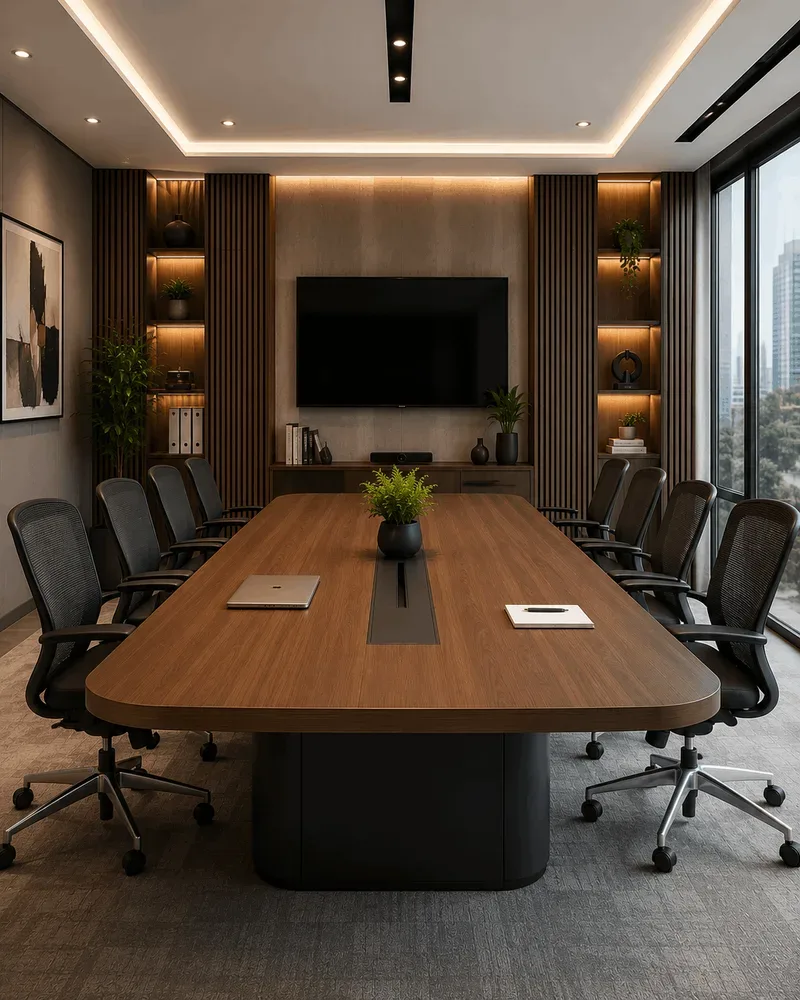
Conference and meeting tables | Check access first | A large top that cannot make the lift or staircase is a problem before it is a decision |
Reception counters | Usually replace | Often built to the old entrance, and rarely fit a new one |
Pantry runs | Usually replace | Tied to the old plumbing and counter dimensions |
Record It So the Decision Survives Scrutiny
An inventory that lives in somebody's head does not survive a procurement review, and it does not survive the person who made it being on leave during the move. Use a single sheet with one row per item type.
Field | What to record | Why it matters later |
|---|---|---|
Item type and count | Description and quantity in use | Separates furniture in use from furniture in storage |
Overall size | Width, depth and height in millimetres | Decides whether it fits the new layout at all |
Dismantles | Yes, no, or unknown | The single field that most often forces a replace decision |
Condition | Structure, edges, channels, locks | Distinguishes cosmetic wear from end of life |
Access at both ends | Lift, staircase, doorway widths | Determines whether the move is even possible |
Outcome | Reuse, resize, replace or dispose | The decision itself |
Reason | One line | What you will be asked to justify |
Fill the outcome column only after the access row, because an item that cannot leave the old building or enter the new one is decided regardless of its condition.
The Resize Question, Answered Honestly
Modifying existing furniture sounds efficient and sometimes is. But be clear about who is willing to do it and what they will stand behind afterwards.
Most manufacturers, Reedify included, do not take on modification of furniture built by another company as a routine service, because the board, hardware and construction method are unknown and no warranty can sensibly follow the work. If you want modification explored, ask specifically and get a written answer rather than assuming it is included in a relocation quote. A vague yes at quotation stage tends to become a no on site, which is the same accountability question covered in the guide on manufacturer or supplier in Gurgaon.
The practical middle path for most Udyog Vihar moves is to reuse the freestanding items, replace the system items with a single new specification, and keep the old and new visually separated by zone rather than interleaved.
Move Logistics Worth Settling Early
Udyog Vihar covers a wide mix of building types, from older industrial-era blocks to modern towers, and access varies a great deal between them. Two sites means two sets of constraints, and both matter.
Lift dimensions and availability at both the old and the new building
Loading bay access and any permitted time windows for material movement
Gate pass and building-management documentation at both ends
Whether dismantling can happen during working hours or has to run after hours
Floor level and staircase turns, where a lift is unavailable or too small
Who carries responsibility for damage during transit of your existing furniture
Reedify confirms access conditions for its own deliveries before dispatch and checks panel sizes against service lift dimensions at the design stage. Where the building restricts daytime movement, installation runs in evening, night or weekend windows. That is described further on the office furniture manufacturer in Gurgaon page, with the full product range on the modular office furniture hub.
For new units ordered as part of a move, the specification is recorded at our Rohtak factory, so a later addition can be produced against the same drawing. Structural cover on new Reedify furniture runs up to 10 years*, with terms by component on the warranty page. Companies moving one NCR office while running others can hold a single specification across sites, including office furniture in Delhi.
Frequently Asked Questions
Related services & next steps