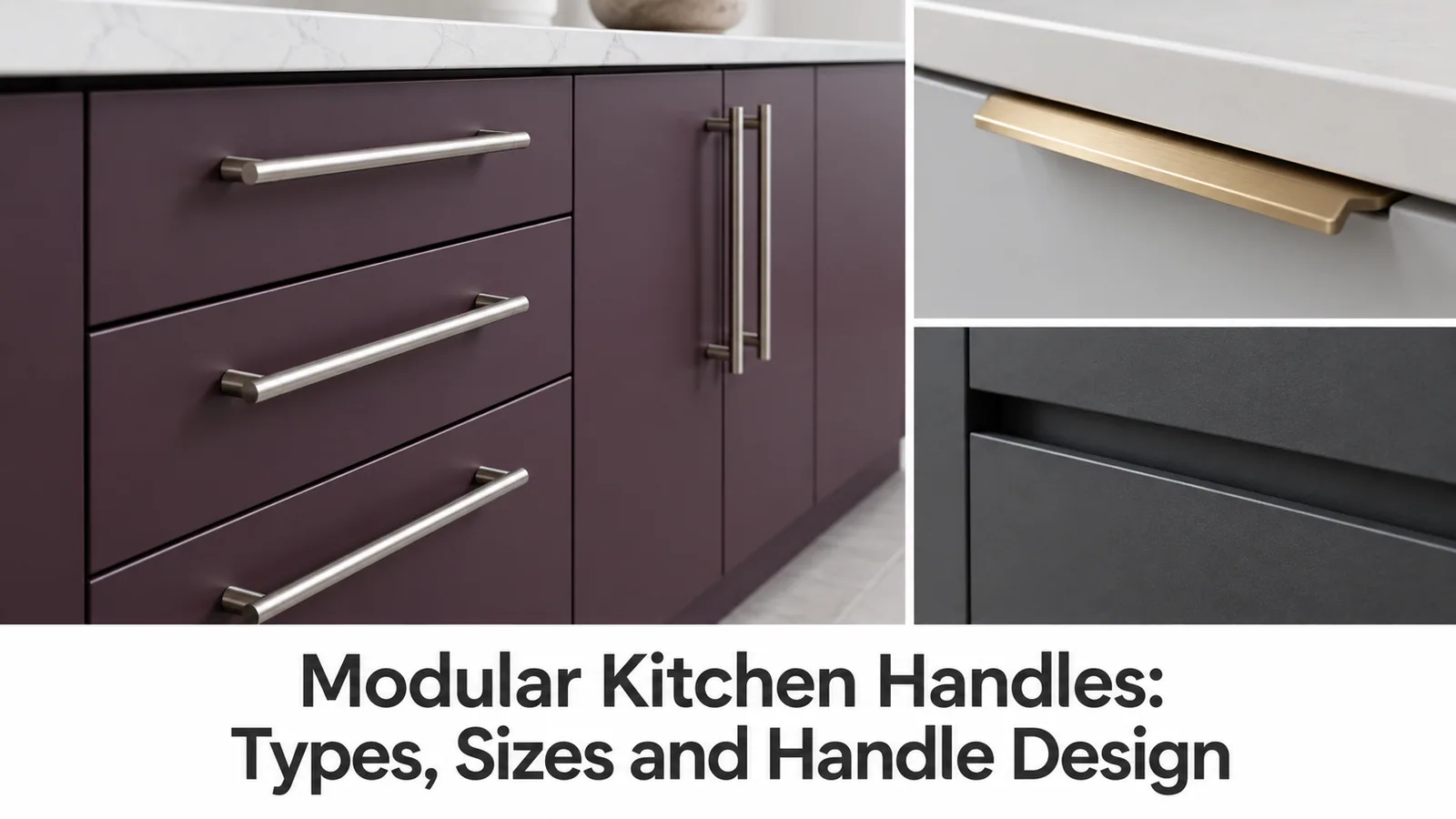
Kitchen handles decide how easily you open every shutter and drawer with wet or oily hands, how often you knock into something in a narrow kitchen, and how much grease collects on the fronts. Bar handles give the firmest grip, especially on heavy drawers full of vessels. Profile and gola handles give a clean, handleless look with nothing to bump into, but they must be planned into the cabinets before production. Push-to-open systems suit wall units better than heavy base drawers. Many Indian kitchens combine two types.
This guide compares every common handle type, explains sizes and placement, covers materials and finishes, and shows how to choose handles that suit the way you cook.
Key Takeaways
Bar handles are the most practical choice for heavy drawers and oily hands.
Gola and profile handles create a handleless look but change how cabinets are built.
Handle sizes are usually given as hole-to-hole distance, often in steps of 32 mm.
Consistent placement across the kitchen matters as much as the style.
A common mix is handleless wall units with bar handles or gola grips on base drawers.
Types of Modular Kitchen Handles Compared
Type | What it is | Strengths | Watch out for |
|---|---|---|---|
Bar or D handle | A handle fixed to the shutter face | Firm grip; easy with heavy drawers; easy to replace | Can snag clothes or hips in narrow aisles |
Knob | A small single-point pull | Compact; suits small shutters | Weak grip on large or heavy fronts |
Cup or shell pull | A curved pull you hook your fingers under | Traditional look; good grip on drawers | Collects crumbs inside the cup |
Edge or J profile | A slim aluminium profile along the shutter edge | Clean look; few protrusions | Grease can gather inside the lip |
Gola profile | A recessed channel fixed to the cabinet, not the shutter | Fully handleless look; nothing to knock into | Must be built into the carcass; recess needs cleaning |
Insert or flush handle | A handle set into a routed slot in the shutter | Flush surface; modern look | Needs a thick enough shutter |
Push-to-open | A mechanism that opens the front when pressed | No visible handle at all | Less suited to heavy drawers; fingerprints show |
Bar Handles: The Practical All-Rounder
Bar handles are the easiest to use when your hands are full or oily, and they give the leverage needed for deep drawers holding pressure cookers, kadhais and steel containers. They are also simple to replace if you want a new look later. In narrow parallel or U-shaped kitchens, choose slim bar handles that do not project far into the aisle.
Profile and Gola Handles: The Handleless Look
Profile handles run along the top or side edge of the shutter, giving a slim line of metal instead of a separate handle. Gola profiles go a step further: the aluminium channel is fixed to the cabinet itself, creating a recessed grip behind the shutter edge. Horizontal gola channels run along the top of base units and between drawers, and vertical channels run beside tall units.
Both create a seamless, modern front that suits open kitchens and homes with young children, since there is nothing to knock into at head or hip height. Because a gola profile changes how the cabinet is built, it has to be decided at the design stage and cannot easily be added later. In Indian cooking, the recess also collects grease and crumbs, so plan to wipe it regularly.
Push-to-Open Systems
Push-to-open mechanisms let a light press open the shutter or drawer. They work well on wall units and light drawers, and they suit very minimal designs. For heavy base drawers, a handle or gola grip is usually more reliable. On gloss shutters, push-to-open leaves fingerprints exactly where you press.
Handle Sizes: How They Are Measured
Handle size is usually given as the centre-to-centre distance between the two screw holes, often written as CC. Many handle systems use sizes in steps of 32 mm, such as 96, 128, 160, 192 and 224 mm. Longer handles suit wider drawers and tall units; shorter handles suit narrow shutters.
Shutter or drawer | Handle choice |
|---|---|
Narrow shutter or small drawer | Short bar handle or knob |
Standard base drawer | Medium bar handle, centred |
Wide or heavy vessel drawer | Longer bar handle or gola grip |
Tall unit door | Long vertical bar handle or vertical gola channel |
Wall unit door | Short handle near the bottom edge, profile handle or push-to-open |
Where to Place Handles
Base unit doors: vertically, near the top corner on the opening side.
Drawers: horizontally, centred across the front.
Wall unit doors: near the bottom corner on the opening side, where you can reach them.
Tall units: vertically, at a comfortable mid-height.
Keep the same height and orientation across the kitchen so the fronts line up.
Materials and Finishes
Kitchen handles commonly come in aluminium, stainless steel and zinc alloy, with finishes such as brushed steel, matte black, gold, champagne and chrome. Stainless steel resists moisture well near the sink. Matte finishes hide fingerprints better than polished ones. Choose a finish that suits your shutter colour and is comfortable to touch with oily hands.
Shutter colour | Handle finishes that suit it |
|---|---|
White or light grey | Matte black, brushed steel or gold |
Wood grain | Matte black or brushed steel |
Navy, green or charcoal | Gold, champagne or brushed steel |
High-gloss acrylic | Profile or gola in matching or contrasting metal |
For shutter options to pair with your handles, see our kitchen finishes comparison.
Choosing Handles for an Indian Kitchen
Heavy cooking: bar handles or gola grips on base drawers give a reliable pull.
Narrow kitchens: profile or gola handles avoid snagging in the aisle.
Children at home: handleless fronts remove protruding edges at head height.
Elderly family members: longer bar handles are easiest to grip.
Easy cleaning: simple bar handles wipe clean quickly; recessed profiles need a brush now and then.
Open kitchens: handleless or slim handles keep the fronts calm from the living room.
Handles and Hardware Work Together
A handle is only as good as the hinge or drawer channel behind it. Heavy drawers need full-extension channels with the right load rating, and handleless systems work best with soft-close hardware. Our kitchen hardware guide explains hinges, channels and drawer systems.
Common Handle Mistakes
Choosing a gola profile after the cabinets are already in production.
Long bar handles that stick out into a narrow aisle.
Small knobs on heavy pull-out drawers.
Push-to-open on drawers holding heavy vessels.
Mixing many handle styles in one kitchen.
Not writing the handle model and size on the quote.
Handles in a Reedify Kitchen
Reedify Modulars manufactures cabinets at its own factory in Rohtak and fits the handle brand and style you choose. If you want a gola or profile system, we plan it into the cabinet construction at the design stage, and every handle is listed on the itemised quote. To choose handles for your custom modular kitchen, share your plan with our team.