
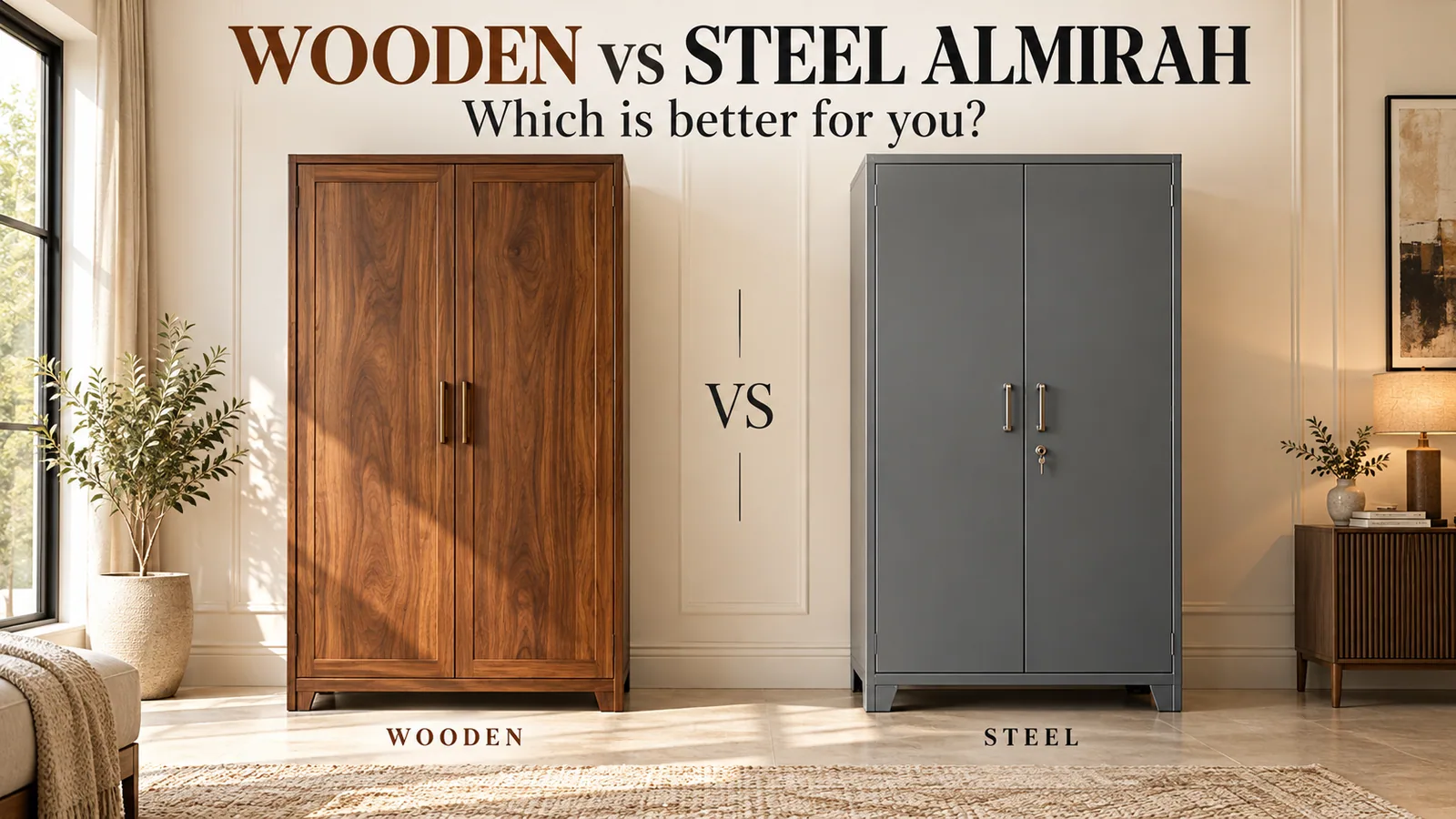
Choose a wooden almirah when you want storage that fits your bedroom wall exactly, matches the room and holds more through a planned internal layout. Choose a steel almirah when you need something portable, lockable and indifferent to pests — for a rented home, frequent transfers, a store room or valuables. Many Indian homes end up with both: a built-in wooden almirah for clothes and a small steel unit or safe for documents and jewellery.
The rest of this guide explains why, so you can match the choice to your room, your climate and how long you plan to stay.
Wooden vs Steel Almirah at a Glance
Factor | Wooden (modular) almirah | Steel almirah |
Fit to the room | Made to the wall's width and ceiling height | Fixed catalogue sizes; gaps at the sides and top are common |
Internal layout | Hanging, drawers, shelves, loft and locker planned to your clothes | Mostly fixed shelves and a hanging section |
Look | Laminate, acrylic, PU, mirror or glass shutters to match the room | Powder-coated finish in a limited range |
Moisture | Needs a suitable board, sealed edges and a dry wall | Rusts if kept on a damp floor or against a seeping wall |
Termites and pests | Depends on the board and site conditions | Not affected |
Moving house | Usually wall-fixed; not designed to be moved | Freestanding and portable |
Security | Can include a lockable drawer or space for a safe | Built-in locker and lock are standard on many models |
Noise and feel | Quiet shutters, soft-close hardware available | Metal doors can clang; shows dents |
Where a Steel Almirah Makes Sense
Steel almirahs have been a fixture of Indian homes for decades for good reasons. They are freestanding, so they move with you. Insects cannot eat them. Many come with an internal locker, and the body itself is hard to force open. They also tolerate rough use in store rooms and shops.
Their weak points are equally clear:
Rust: a steel almirah standing on a wet floor, or pressed against a wall with seepage, will rust from the bottom and back. Keep it on raised feet and off damp walls.
Dents and scratches: once the powder coating is chipped, the bare metal underneath is exposed to moisture.
Fixed sizes: a standard steel unit rarely fills a wall. You lose the space at the sides and above it, and the area on top usually becomes a dust-collecting pile of suitcases.
Limited layout: the shelves and hanging rail are where the factory put them, not where your clothes need them.
If you are buying steel, check the sheet thickness (with sheet metal, a lower gauge number means a thicker sheet), the quality of the powder coating, the hinges and the lock. A heavier, thicker body resists denting and lasts longer.
Where a Wooden Almirah Makes Sense
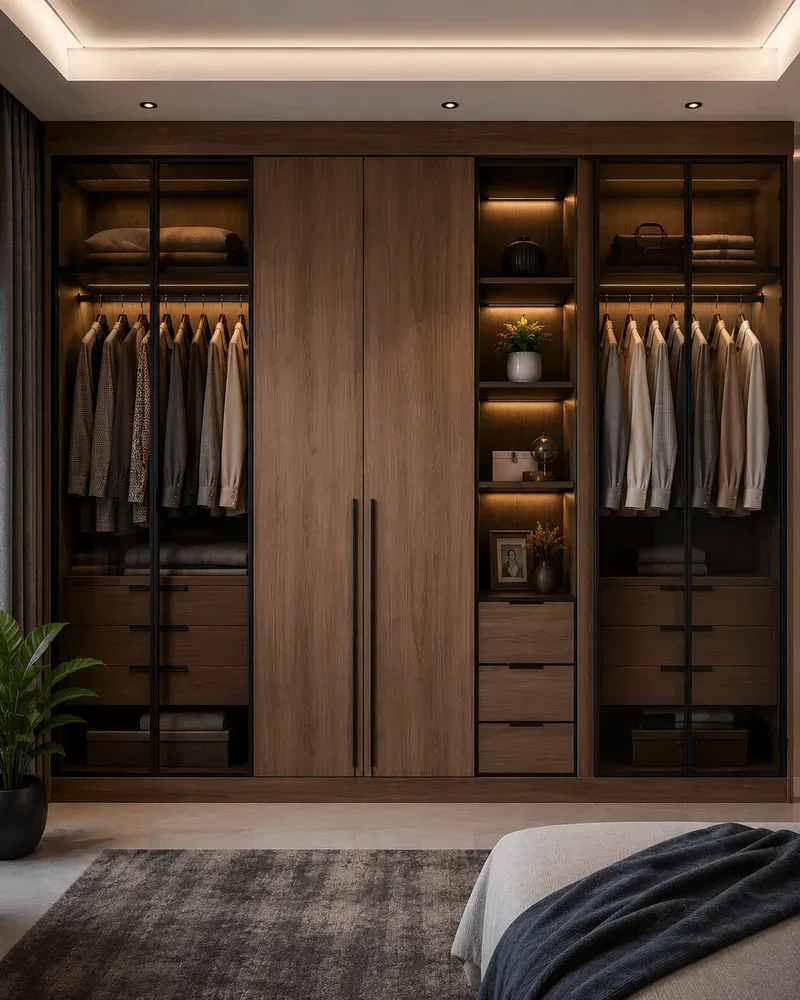
A modular wooden almirah is built for the room it stands in. It can run floor to ceiling, include a loft for luggage, wrap around a corner and match the bed, side tables and other furniture. Inside, the layout is decided before manufacturing: long hanging for sarees and coats, short hanging for shirts, drawers for innerwear and accessories, shelves for folded clothes and a lockable section if you want one.
Its limitations are about where and how it is used:
It is not meant to move. A wall-fixed almirah stays with the room. If you are likely to relocate within a year or two, this matters.
Moisture needs planning. A suitable board, sealed edges and a check for wall seepage before installation are what keep it in shape through the monsoon.
Cost scales with size. A full-wall unit with a loft and mirror shutters costs more than a basic two-door steel almirah, because it does far more.
The board and finish choices behind a long-lasting wooden unit are explained in the wardrobe materials and finishes guide.
Moisture, Rust and Termites in North Indian Homes
Climate is often the deciding factor. Monsoon humidity affects both types, just differently. Steel rusts where water sits; wood-based boards swell where water gets into an unsealed edge.
Check the wall for damp patches or seepage before choosing where the almirah goes. Fix the seepage first.
For a wooden almirah, ask for the board grade and how the edges are sealed, and confirm the board's treatment against termites and borers from the manufacturer's specification.
For a steel almirah, keep it raised off the floor and away from bathroom walls and wet balconies.
In ground-floor rooms and older buildings, discuss site conditions with the installer before deciding.
Security and Valuables
The traditional reason for buying steel is the locker. A wooden almirah can still keep valuables secure: plan a lockable drawer, or leave a fitted space inside for a small safe that is bolted down. This combination gives you the look and storage of a built-in wooden almirah with the security of steel where it actually matters.
Space, Doors and Fit
In small bedrooms the door type matters as much as the material. Hinged shutters need clear space in front to swing open; sliding shutters do not, but they need track depth and only show part of the almirah at a time. The trade-offs are covered in sliding vs hinged wardrobes. If you want a mirror on the shutters, review the options for a wardrobe with mirror before the design is finalised.
Choose a wooden almirah if
You own the home or will stay for several years.
You want to use the full wall, including the space above for luggage.
You need an internal layout planned around your clothes.
The almirah should match the rest of the bedroom.
Choose a steel almirah if
You rent or expect to move soon.
It is going into a store room, garage or shop.
Pest risk in the room is high and cannot be fixed.
You mainly need a lockable unit for documents and valuables.
Consider both if
You want a built-in wooden almirah for daily clothes and a compact steel unit or safe for valuables. It is a common and sensible split.
Planning the Inside of a Wooden Almirah
Most of the value of a wooden almirah is inside it. Before the design is finalised, count what you actually store: how many items hang long, how many hang short, how much is folded and how many accessories and bags you keep. The internal layout planning guide works through this step by step.
What Drives the Cost of Each
For steel almirahs, cost follows size, sheet thickness, finish quality and the number of lockers and drawers. For wooden almirahs, cost follows wall size and height, door count and type, board, finish, mirror or glass work, drawers, loft storage, accessories and installation. A wooden almirah quote is only meaningful after the wall has been measured and the internal layout agreed.
Custom Wooden Almirahs from Reedify Modulars
Reedify Modulars designs each custom wooden almirah to the measured wall, with the internal layout planned around what you actually store.
Share your room size and the wall you want to use when you reach the Reedify team.