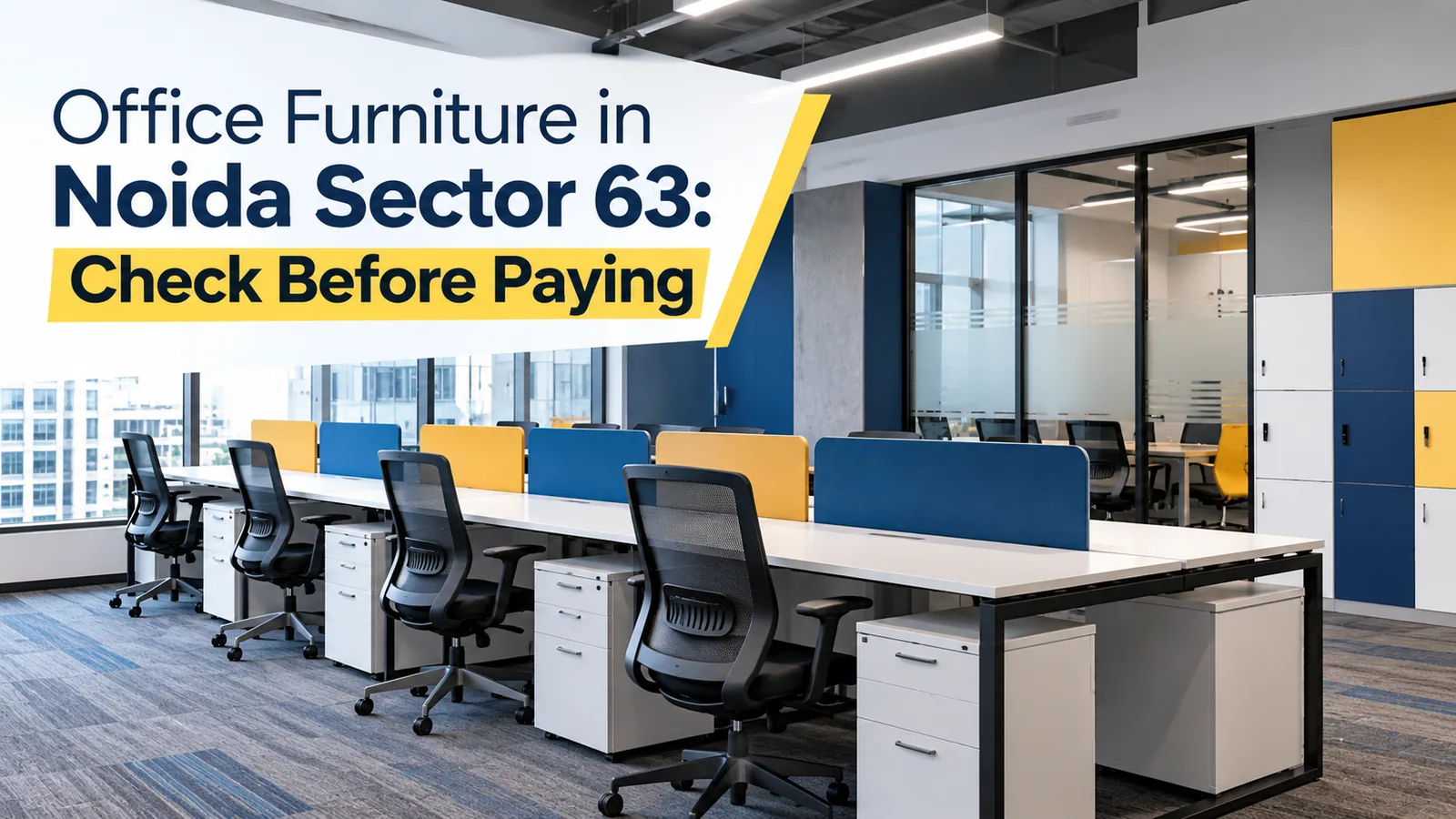
Sector 63 is where a lot of Noida office furniture searches end up, and for good reason. It is central to the working corridor, there are units to look at, and somebody can usually meet you the same week. The problem is not finding a supplier there. It is that a showroom visit feels conclusive when it is not, and an advance usually goes out before the buyer has asked the four questions that matter.
What a Showroom Visit Proves, and What It Does Not
A visit proves that a physical unit exists and that you liked it. That is genuinely useful. It does not prove that the unit you liked is the unit that will be built for you, that the person selling it made it, or that it will fit your floor.
Those three gaps are where almost every office furniture dispute starts. None of them is hard to close. They just have to be closed before money moves, because afterwards your leverage is gone.
Check One: Is the Sample the Same Thing You Will Receive
A display unit is built to be looked at. Ask directly whether your order will be produced to the same specification as the sample, and then get that specification on paper rather than on trust.
The board material and its thickness in millimetres, for the worktop and for the vertical panels separately
The edge band material and thickness, and whether it goes on all four edges or only the front
The hardware brand and series for channels, hinges and locks, and whether channels are soft-close
The finish name and colour code, not just the shade you pointed at
Every dimension in millimetres, including worktop height and pedestal height
If the answer to any of these is a category rather than a specification, the sample and your order are two different products. The full version of this exercise, with a table you can send to three bidders at once, is in the guide on comparing manufacturer quotes in Noida.
Check Two: Who Are You Actually Paying
Ask where the furniture is manufactured and whether you can see the place. A manufacturer will name the location. A trading arrangement will describe a facility without offering an address, and there is nothing wrong with that model as long as you know that is what you are buying, because it changes who answers the phone in year three.
Then check the paperwork side. The quotation and the invoice should carry the same legal entity name, with GST details, and the warranty should be issued under that same name. Where the three names differ, ask why before the advance rather than after a failure.
Check Three: Is the Scope Written Down
Furniture price and delivered price are different numbers. Get each of these confirmed in writing on the quotation itself, not agreed verbally in the showroom:
Transport to the building, and separately, movement from the loading bay to your floor
Whether the service lift is booked by the supplier or by you
Assembly only, or assembly plus levelling and wall anchoring
Packaging removal from the site on the day of installation
A delivery date, expressed as a date rather than a range of days
Days allowed for closing snags after handover
What the advance covers if you cancel before production starts
Check Four: Has Anyone Measured Your Office
This is the one Sector 63 buyers skip most often, because the furniture was picked in a showroom and the office feels like a detail to sort out later. It is not a detail. A cluster that is 200 mm wider than the wall run does not become narrower on delivery day, and a conference table top that does not fit the service lift becomes a staircase problem.
Before the advance, confirm that someone has measured the room in millimetres, noted door swings, columns, electrical points and air-conditioning positions, and checked panel sizes against the lift car. If the supplier has not been to your floor, ask who carries the cost when something does not fit. The answer belongs in the quotation.
Reedify measures on site before quoting, at no charge and with no obligation, and the layout is approved by you in 3D before any panel is cut. The full process is set out under our working model.
About the Advance Itself
An advance is normal in this trade. Custom furniture is produced against your drawing, so the maker carries real exposure if an order is abandoned mid-production. What is not normal is an advance against a one-line description.
Before you transfer anything, make sure three documents exist: the specification sheet, the approved layout or drawing, and a quotation that includes the delivery and installation scope. With those in hand, an advance is a reasonable commitment. Without them, it is a deposit on an unspecified object.
When You Are in a Hurry
Sometimes the office opens in ten days and none of this fits the timeline. That is a legitimate reason to buy stock furniture from a market rather than order to size, and it is worth being honest with yourself about it rather than pretending a rushed custom order will go smoothly.
If you take that route, buy the full quantity in one go, and run the same sample checks set out for buying office furniture in Kirti Nagar, which apply to any furniture market. Market stock rotates, and a matching set bought six months apart is rarely matching. If the floor is going to grow, the calculation changes, and furniture manufactured against a recorded specification becomes worth the extra weeks.
It is also worth separating the urgent part from the rest. A team that must sit down on Monday needs desks and chairs; it does not need the boardroom table, the reception counter or the storage wall in the same week. Buying the urgent items quickly and ordering the matched, longer-lived items properly is usually a better outcome than rushing the whole floor and living with it for five years.
Reedify Modulars manufactures at its own 12,000 sq ft factory in Rohtak and serves Noida and Greater Noida directly, with no showroom and no dealer in the chain. The full scope for the city is on the office furniture manufacturer in Noida page, and the twelve product lines on the modular office furniture hub. Structural cover runs up to 10 years*, with terms by component on our warranty and service support page.
What Should Happen After the Advance
A reasonable supplier relationship is visible in the weeks after payment, not in the meeting before it. Agree at the outset what you will hear and when, because silence for three weeks is the point at which most buyers start calling.
Confirmation that production has started, against the approved drawing
A dispatch notice before the furniture leaves the factory, not on the day it arrives
An installation slot agreed with you, and with the building where a lift booking is needed
A handover walk on site, comparing what is installed against the drawing you approved
A written snag list from that walk, with a closure date against each item
The warranty document issued after handover, in the same entity name as the invoice
If a supplier cannot describe that sequence when you ask, it usually means the sequence does not exist and the next few weeks will run on phone calls. Reedify's version of it is set out stage by stage under our working model, with measurement on day one and handover under 45 days on a typical project.